|
 |
 |
 |
 |
 |
 |
 |
 |

 |
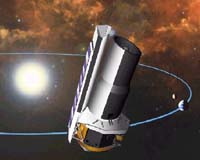
Cryogenic Telescope Ready For Launch
Boulder - Apr 08, 2003 The Space Infrared Telescope Facility (SIRTF), carrying the Ball Aerospace cryogenic telescope assembly and two Ball-built science instruments, is scheduled to launch from Cape Canaveral, Fla., on April 18. SIRTF is the fourth and final mission in NASA's Great Observatories series. Ball Aerospace has had a significant role on all four of the Great Observatories. SIRTF will observe objects from the outer solar system to the most luminous known galaxies in the farthest reaches of space. By studying the infrared thermal energy emitted by distant objects in the universe, astronomers will gain significant knowledge regarding the formation and evolution of the universe. "With the launch of SIRTF, Ball Aerospace has come full-circle in providing remarkable, one-of-a-kind instruments for every NASA Great Observatory," said Jerry Chodil, vice president and general manager of Civil Space Systems for Ball Aerospace. "We have been a partner on the Hubble Space Telescope, launched in 1990, including six instruments for its follow-on servicing missions, and also the Compton Gamma Ray Observatory launched in 1991, and the Chandra X-ray Observatory in 1999." The innovative Cryogenic Telescope Assembly (CTA) system built by Ball Aerospace under contract to the Jet Propulsion Laboratory, provides the low temperature of 1.4 K above absolute zero required for sensitive observations by the three instruments. "The CTA is the first-of-its kind and the most complex cryogenic system ever developed by Ball Aerospace," said Chodil. Ball Aerospace also built SIRTF's Infrared Spectrograph (IRS) under contract to Cornell University and the Multiband Imaging Photometer (MIPS) for SIRTF under contract to the University of Arizona. The IRS breaks lights into its various wavelengths, much like a prism, to help astronomers study the composition of cosmic objects. MIPS is a far-infrared instrument capable of imaging photometry, high-resolution imaging, and scan mapping. SIRTF's lifetime requirement is two-and-a-half years, with a goal of five years. As part of the NASA Origins program, SIRTF will further discoveries initiated by the previous three Great Observatories. It will also help prepare the scientific framework for future missions such as the James Webb Space Telescope, for which Ball Aerospace is the principal subcontractor to develop the telescope optical system. Community Email This Article Comment On This Article Related Links Space Infrared Telescope Facility Ball Aerospace & Technologies Corp SpaceDaily Search SpaceDaily Subscribe To SpaceDaily Express Space Technology News - Applications and Research
 TeleRay Mobile Sat TV Antenna For Japan Auto Market
 Las Vegas CA (SPX) Jan 5, 2006
RaySat has introduced TeleRay, the world's smallest satellite TV vehicle antenna, into the domestic Japanese automotive market.
--------------------------------------------------------- It's new. And it's downright terrific! Celestron's CPC Schmidt-Cassegrain telescope is the scope you've been waiting for! It offers new alignment technology, advanced engineering, and bold new design at a new, low price! In fact, Celestron's Professional Computerized (CPC) scope with revolutionary SkyAlign Alignment Technology redefines everything that amateur astronomers are looking for. It offers quick and simple alignment, GPS technology, unsurpassed optical quality, ease of use, advanced ergonomics, enhanced computerization and, most important, affordability. Want to view M-31 tonight? One button takes you there!
Shop for telescopes online at Telescopes.com! today!
|
|
|

| The content herein, unless otherwise known to be public domain, are Copyright 1995-2006 - SpaceDaily.AFP and UPI Wire Stories are copyright Agence France-Presse and United Press International. ESA PortalReports are copyright European Space Agency. All NASA sourced material is public domain. Additionalcopyrights may apply in whole or part to other bona fide parties. Advertising does not imply endorsement,agreement or approval of any opinions, statements or information provided by SpaceDaily on any Web page published or hosted by SpaceDaily. Privacy Statement |