|
 |
 |
 |
 |
 |
 |
 |
 |

 |
Cruising On Sunshine
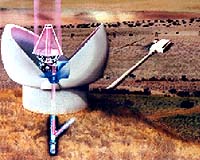
Huntsville - Jan 11, 2002 Try this: Close your eyes and imagine the International Space Station (ISS), sunlit and gleaming as it circles our planet. What did the ISS look like? The lingering image in your mind is probably dominated by broad, beautiful wings -- the station's awesome solar arrays. It's no accident that solar panels dominate the station's profile. On the ISS (as on the earth below) solar energy ultimately powers everything that happens. Our Sun, a star named Sol, radiates enormous power: a constant output of 4 x 10²³ kilowatts (kW), which is a 4 followed by 23 zeros! Photovoltaic cells, which convert sunlight to electricity, need only intercept a tiny fraction of that total to energize the station. But not all spacecraft linger near Earth where sunlight is plentiful. Many NASA probes travel far beyond our planet's orbit. And as they do, the Sun grows more distant and dim. Somewhere out there, solar power ceases to be a useful source of energy for spacecraft. But where? That's what NASA spacecraft builders want to know: Where is the edge of sunshine? The Space Station's solar cells, developed decades ago, convert 14% of the Sun's energy that hits them into electricity, and modern multibandgap cells, which convert light in multiple parts of the spectrum into electric power, reach efficiencies of 30% or so. Such devices work well enough in the brightly-lit inner solar system, but more efficient cells and larger arrays will be needed as spacecraft travel to places where solar photons are scarce. In the outer reaches of the solar system, for instance, the ability to convert even single photons into electricity would be important. "Sunlight decreases in intensity over distance by a factor of 1/r^2, where r is the distance from the Sun," explains Geoff Landis, a scientist at NASA's Glenn Research Center. "This means a 1-meter-square solar array producing 400 watts at a distance of 1 AU would have to be 25 square meters in size out at Jupiter -- and almost 2,000 square meters at Pluto to yield the same power." (Note: An astronomical unit or "AU" is the mean distance between Earth and the Sun. 1 AU equals 150 million kilometers.) Landis and his colleagues at Glenn's Photovoltaics and Space Environment Branch are exploring new ways to harness the Sun's power -- including more efficient solar cells, laser-beaming energy to distant spacecraft, and solar power systems for the Moon and Mars. "The use of solar power is a complex field of study," says Landis. "Finding solutions requires that we balance such factors as distance, weight, the energy of different light bands, and the actual materials available to us." "Using today's technologies," he says, "the 'edge' of sunshine we can use is about four astronomical units away from the Sun, where the sunlight is about one-sixteenth as bright as it is near the Earth." That's beyond the orbit of Mars (1.5 AU), but closer to the Sun than Jupiter (5.2 AU). "With tomorrow's technologies we hope to push that edge further out into the solar system," he says. "Future solar collectors, for example, might use advanced thin films -- almost like Saran Wrap -- and very lightweight solar cells, which can roll out to an acre or more in size. Instead of a spacecraft that carries a solar array with it, you would have a solar array that carries a spacecraft." Such expansive sails would also be targets for fast-moving space-dust, so they would need to be crafted from puncture-resistant or self-sealing materials. Yet another challenge for spacecraft builders! Sail for the Stars." To date, the farthest any solar-powered spacecraft has ventured from the Sun is 2.35 AU -- a record set last October by NASA's Stardust probe. Stardust will extend its own record every day until April, 2002, when it will reach a maximum distance from the Sun of 2.72 AU en route to Comet Wild 2. Stardust's solar arrays are actually producing more energy than expected, perhaps because its photovoltaic cells operate more efficiently in the cold of deep space than in Earth labs. No one is certain; this is unexplored territory. Not quite as far from the Sun as Stardust, NASA's experimental spacecraft Deep Space 1 recently tested a "solar concentrator" -- 720 lenses that focused sunlight onto 3600 solar cells. Deep Space 1 was the first solar-powered probe to rely entirely on triple-junction multibandgap cells. The small but innovative system generated 2500 watts: enough to energize three microwave ovens and more than enough to power the craft's ion engine. Such advances will eventually propel solar power into deep space -- perhaps out of the solar system altogether. "In the long term, solar arrays won't have to rely on the Sun," Landis said. "We're investigating the concept of using lasers to beam photons to solar arrays. If you make a powerful-enough laser and can aim the beam, there really isn't any edge of sunshine-- with a big enough lens, we could beam light to a space-probe halfway to alpha-Centauri!" Beaming light power to targets on Earth, in orbit, on the Moon or on Mars and other planets -- or to distant spacecraft -- is the stuff of science fiction. That's right up Geoff Landis' alley. He's also a Hugo and Nebula award-winning science fiction writer! As a scientist he and his NASA cohorts are in the business of reaching out to the edge of sunshine every day, seeing fiction very rapidly and certainly turning into fact. Community Email This Article Comment On This Article Related Links Beam Power to Space at Glenn SpaceDaily SpaceDaily Search SpaceDaily Subscribe To SpaceDaily Express Space Technology News - Applications and Research
 Industry Team Achieve New Communications Technology With AESA Radars
 Baltimore MD (SPX) Jan 12, 2006
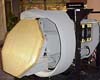
A team comprised of three leading US aerospace and defense contractors has demonstrated an innovative technological use of active electronically scanned array (AESA) radars for high-bandwidth communications. |
|
|

| The content herein, unless otherwise known to be public domain, are Copyright 1995-2006 - SpaceDaily.AFP and UPI Wire Stories are copyright Agence France-Presse and United Press International. ESA PortalReports are copyright European Space Agency. All NASA sourced material is public domain. Additionalcopyrights may apply in whole or part to other bona fide parties. Advertising does not imply endorsement,agreement or approval of any opinions, statements or information provided by SpaceDaily on any Web page published or hosted by SpaceDaily. Privacy Statement |