
 |
 |
 |
 |
 |
 |
 |
 |
 |

 |
Crossing A Bridge To Nowhere
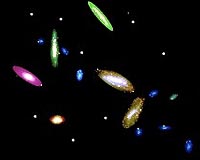
Tel Aviv, Israel (SPX) Oct 21, 2008 Despite thousands of years of research, astronomers know next to nothing about how the universe is structured. One strong and accepted theory is that large galaxies are clustered together on structures similar to giant soap bubbles, with tinier galaxies sprinkled on the surface of this "soapy" layer. New observations from Tel Aviv University are giving new strength to this theory. A team led by Dr. Noah Brosch, Director of the Tel Aviv University-owned Wise Observatory, is the first in the world to uncover what they believe are visible traces of a "filament" of dark matter -- an entity on which galaxies meet, cluster and form. A filament can originate at the junction of two "soap bubbles," where the thin membrane is thicker. Dr. Brosch, with his M.Sc. student Adi Zitrin and researchers from Cornell University, studied an area of the sky opposite the constellation Virgo, where 14 galaxies were forming in a line. Pundits have called the line a "Bridge to Nowhere" because it seems to start and end in unknown locations. Strangely, 13 of these galaxies were simultaneously giving birth to new stars.
"A Hair on the Beard of the Creator" "There has long been a theoretical belief that this was the case," says Dr. Brosch, "but this new finding represents experimental results that such a filament really exists, and that possibly it is an entity made from dark matter which is aligning these galaxies." Dr. Brosch compares the work of an astronomer to "looking for hairs of the beard of the Creator." This line of galaxies may be one such hair. Generally speaking, matter as we know it on earth makes up only a small percentage of our universe. The composition of most of the universe is unknown -- it's either dark matter (about one quarter of the universe) or dark energy (the other three-quarters). "Our studies show that you don't need to go to the edge of the universe to find dark matter. It may be only 15 million light years away, more or less in our backyard," says Dr. Brosch. The research has massive implications for astronomy and the understanding of galaxy-formation. And due to the surprising closeness of this new grouping of galaxies to ours, it would only be a matter of technological advances -- maybe a couple of hundred years -- and a longer human lifespan before explorers could visit this unusual dark matter in person. "Our technology is abysmally limited right now, but it could definitely happen," says Dr. Brosch. Community Email This Article Comment On This Article Share This Article With Planet Earth
Related Links Tel Aviv University Stellar Chemistry, The Universe And All Within It
 Scientists Detect Cosmic Dark Flow Across Billions Of Light Years
 Washington DC (SPX) Sep 24, 2008
Using data from NASA's Wilkinson Microwave Anisotropy Probe (WMAP), scientists have identified an unexpected motion in distant galaxy clusters. The cause, they suggest, is the gravitational attraction of matter that lies beyond the observable universe. |
|
|

| The content herein, unless otherwise known to be public domain, are Copyright 1995-2007 - SpaceDaily.AFP and UPI Wire Stories are copyright Agence France-Presse and United Press International. ESA Portal Reports are copyright European Space Agency. All NASA sourced material is public domain. Additional copyrights may apply in whole or part to other bona fide parties. Advertising does not imply endorsement,agreement or approval of any opinions, statements or information provided by SpaceDaily on any Web page published or hosted by SpaceDaily. Privacy Statement |
 del.icio.us
 Digg
Digg Reddit
 YahooMyWeb
 Google
 Facebook