
 |
 |
 |
 |
 |
 |
 |
 |
 |

 |
Crippled MIR Creates Crisis For NASA
Washington, DC - June 26, 1997 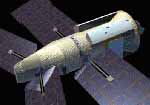 Washington, DC - June 26, 1997 Within hours of the MIR space station collision with the Progress resupply vehicle, officials at NASA were studying whether U.S. astronauts would continue to occupy the aging orbital home. And another plan was being reviewed: how the U.S. space shuttle fleet might once again be used in a station rescue mission. NASA sources told SpaceCast that the incident has forced yet another reappraisal of the joint shuttle-MIR space missions, and how the already tight shuttle manifest could be altered to possibly bring emergency equipment and new solar arrays to the damaged station. Washington, DC - June 26, 1997 Within hours of the MIR space station collision with the Progress resupply vehicle, officials at NASA were studying whether U.S. astronauts would continue to occupy the aging orbital home. And another plan was being reviewed: how the U.S. space shuttle fleet might once again be used in a station rescue mission. NASA sources told SpaceCast that the incident has forced yet another reappraisal of the joint shuttle-MIR space missions, and how the already tight shuttle manifest could be altered to possibly bring emergency equipment and new solar arrays to the damaged station.
Space officials in Washington and at Johnson Space Center in Houston, Texas are also looking at how a docked shuttle could render assistance to a spacewalking crew of both cosmonauts and astronauts in a bold joint effort to repair the damaged Spektr module. A spacewalk by Russian cosmonauts seems the only way the breach in the hull of the module could be repaired enough to allow it to be returned to service, along with its suite of solar power cells that provide electrical power to the entire MIR complex. Wednesday's accident, in which an unmanned Progress cargo craft struck a solar array and the side of the fuselage of the Spektr module, caused half of MIR's power to be lost, and also caused oxygen in the unit to begin leaking out to space. Quick action by the crew on board, including U.S. astronaut Michael Foale, led to sealing off the module and saving the rest of the MIR complex. But since much of the U.S.'s life science equipment is located in the Spektr module, most of Foale's research was halted by the shutdown. The power loss has virtually crippled the rest of the MIR as well, effecting everything from the station's gyrodyne control system to internal life support and lighting. "It's pretty much a cold, dark ship now," said U.S. astronaut Jerry Linenger, himself back from a four month stay on MIR that saw power problems and even a fire. While NASA sought to review its plans and looked at possible rescue scenarios, another struggle was getting underway for MIR's future on the ground here in Washington. While the crew aboard the MIR were battling its crippled power loss, U.S. politicians were wasting no time in using the latest MIR crisis as an excuse to blast the Clinton administration's space policy. Rep. F. James Sensenbrenner (R-WI) called the incident more proof of MIR's unsafe condition. Sensenbrenner, chair of the U.S. House Science Committee, confronted NASA Administrator Daniel Goldin later in the day, and demanded Goldin not place another U.S. flyer on the Russian station until Goldin certifies to Congress that the station "meets or exceeds U.S. safety standards". But the fiesty NASA chief is refusing to bow to Congressional critics, saying that a recent outside review panel reported MIR's condition was safe enough for continued missions. As the latest crisis on the Russian space station becomes the focus of new repair and reengineering work by both space powers, the politicos may seize the opportunity to force NASA to either cancel the shuttle-MIR exchanges until the International Space Station is built, beginning next year, or devise some way to stabilize the 11-year old space base so that is lasts until the International Space Station facility is built. Sensenbrenner and other Congressional Republicans might hold the NASA budget hostage this summer until MIR�s various problems are resolved. One thing is certain: the future of both the U.S. space program and that of the Russian Federation are once again in jeopardy, thanks to a crisis in the world's oldest occupied spacecraft, and thus far, still the only space station in orbit. Community Email This Article Comment On This Article Related Links Space
 Satellite Launch To Boost DTH In India
 Calcutta, India (SPX) Dec 28, 2005
The successful launch Thursday of India's heaviest satellite from spaceport of Kourou in French Guyana may have boosted the country's space research efforts to yet another level, but it has also lifted the spirits of at least three Direct-To-Home televisions broadcasters, one of which has been waiting for years to launch its services in India. |
|
|

|
|
|
|
|
|
|
|
|
|
|
|
| The content herein, unless otherwise known to be public domain, are Copyright 1995-2006 - SpaceDaily.AFP and UPI Wire Stories are copyright Agence France-Presse and United Press International. ESA PortalReports are copyright European Space Agency. All NASA sourced material is public domain. Additionalcopyrights may apply in whole or part to other bona fide parties. Advertising does not imply endorsement,agreement or approval of any opinions, statements or information provided by SpaceDaily on any Web page published or hosted by SpaceDaily. Privacy Statement |

