|
 |
 |
 |
 |
 |
 |
 |
 |

 |
Crew 10 Repressurize Space Station For Next Residents Arriving April 16
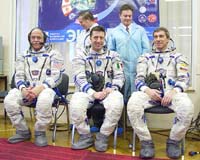
Houston TX (SPX) Apr 11, 2005 Last week, the current International Space Station crew started to pack-up for home while the next Station crew completed a final review of plans before heading to the Baikonur Cosmodrome, Kazakhstan, to prepare for launch. Last Monday Expedition 10 Commander Leroy Chiao and Flight Engineer Salizhan Sharipov held an in-flight news conference with reporters at NASA centers. They discussed Station systems, lessons learned from two-man crew operations on the Station and the return of the Space Shuttle to flight. Chiao and Sharipov performed some maintenance work this week as well, including re- pressurizing the Station atmosphere with oxygen from the Progress supply ship's tank. They discharged two carbon dioxide-removing lithium hydroxide canisters that were nearing their expiration dates while ground specialists monitored the Station's environment to gauge the efficiency of the Russian canisters for possible future use. Flight controllers and engineers are continuing to analyze several spikes in vibration and electrical current that have been noted in one of the Control Moment Gyroscopes. The two functional gyroscopes are operating well and continuing to control the Station's orientation. While the analysis continues, the Station is in an orientation that minimizes demands on the gyroscopes. Remaining in that orientation does not change other Station operations. The ongoing analysis focuses on attempts to correlate the events with activity aboard the Station. Research aboard the Station this week included the crew taking a close look at themselves. Chiao and Sharipov conducted their final session with the Advanced Diagnostic Ultrasound in Microgravity (ADUM) experiment. Chiao and Sharipov performed ultrasound bone scans on each other by taking turns as operator and subject. The bone scans were taken of the shoulder, elbow, knee and ankle, monitored remotely from the ground, and videotaped and photographed for downlink. While an ultrasound cannot image bone porosity itself, the ADUM team is looking at the bone surface roughness as an indicator of bone density. Their hypothesis is that during muscle atrophy the bones may become smoother as fewer muscle and ligament attachment sites are required. Therefore by monitoring the surface roughness of bones, it may be possible to get some indication of how much muscle has been lost and possibly how much bone has been lost as well. If successful, in the future, this could lead to changes in exercise protocols that could be adapted to individuals in near real time. For his Saturday Science activities last weekend, Chiao conducted a session with the Miscible Fluids in Microgravity, or MFMG experiment. Fluids do not behave the same on Earth as in the microgravity environment inside the orbiting Station. This experiment studies how miscible fluids, or those that completely dissolve, interact without the interference of gravity. This test involved Chiao pulling tinted water from a syringe through a drinking straw and into another syringe containing a mixture of honey and water. The way the fluid interacted was both videotaped and photographed for observation. This research could help scientists improve the way plastics and other polymers are produced on Earth and in space. The payload operations team at NASA's Marshall Space Flight Center coordinates U.S. science activities on the Station. At the Gagarin Cosmonaut Training Center in Star City, Russia, the next Station crew, Expedition 11, spent the week reviewing flight plans. Commander Sergei Krikalev and Flight Engineer John Phillips, along with European Space Agency (ESA) Astronaut Roberto Vittori will travel to Kazakhstan tomorrow ahead of their launch. Vittori will fly to the Station for eight days under a commercial agreement between Russia and ESA. He'll return to Earth with the Expedition 10 crew. The Expedition 11 crew and Vittori will launch in their Soyuz spacecraft at 8:46 p.m. EDT Thursday, April 14. They will dock at the Station's Pirs docking compartment at 10:19 p.m. EDT April 16. This will be the 10th Soyuz to dock with the Station. Vittori, Chiao and Sharipov are scheduled to land in Kazakhstan on April 24. Video of launch preparations at Baikonur will air on NASA TV daily, beginning Monday. NASA TV will broadcast the launch live starting at 8 p.m. EDT April 14. Community Email This Article Comment On This Article Related Links ISS at NASA SpaceDaily Search SpaceDaily Subscribe To SpaceDaily Express Space Station News at Space-Travel.Com
 NASA Had No Choice But To Buy Soyuz Flights
 Washington DC (SPX) Jan 09, 2006
NASA's announcement last week that it will pay Roskosmos $43.6 million for a round-trip ride to the International Space Station this spring, and an equivalent figure for an as-yet-undetermined number of future flights to the station until 2012, represents the agency's acknowledgment that it had no alternative. |
|
|

| The content herein, unless otherwise known to be public domain, are Copyright 1995-2006 - SpaceDaily.AFP and UPI Wire Stories are copyright Agence France-Presse and United Press International. ESA PortalReports are copyright European Space Agency. All NASA sourced material is public domain. Additionalcopyrights may apply in whole or part to other bona fide parties. Advertising does not imply endorsement,agreement or approval of any opinions, statements or information provided by SpaceDaily on any Web page published or hosted by SpaceDaily. Privacy Statement |