|
 |
 |
 |
 |
 |
 |
 |
 |

 |
Creeping Crinoids! Sea Lilies Crawl To Escape Predators, Video Shows
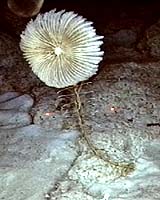
Salt Lake City UT (SPX) Oct 18, 2005 With their long stalks and feathery arms, marine animals known as sea lilies look a lot like their garden-variety namesakes. Perhaps because of that resemblance, scientists had always assumed that sea lilies stayed rooted instead of moving around like their stalkless relatives, the feather stars. But videos taken from a submersible research vessel at a depth of 430 meters (1410 feet) near Grand Bahama Island reveal that some sea lilies can creep along the ocean floor, apparently to escape from sea urchins that prey upon them. The video and related studies help paint a bigger picture of the evolution and ecology of these deep-sea creatures and their predators. University of Michigan professor of geological sciences Tomasz Baumiller showed the videos and discussed the research Oct.16 at a meeting of the Geological Society of America in Salt Lake City, Utah. Sea lilies and feather stars, members of a group called crinoids, are closely related to starfish, sea cucumbers and sea urchins. The two main types of crinoids look a lot alike except that sea lilies have stalks, and feather stars do not. In addition, feather stars are known to crawl, and some can even swim, but sea lilies were thought not to have such abilities. However, Baumiller and collaborator Charles Messing of Nova Southeastern University's Oceanographic Center in Dania Beach, Fla., have long suspected that some sea lilies are able to move around. In previous work, the researchers found that some sea lilies regularly shed and regenerate the ends of their stalks. Interestingly, the stalks don't break off just anywhere, but at particular nodes, just below clusters of flexible, finger-like appendages. Baumiller and Messing speculated that the sea lilies might be shedding the ends of their stalks to release themselves from the places where they were anchored, then somehow moving to another location and using the fingers to reattach. In the late 1980s the researchers observed that sea lilies could, in fact, move from place to place - Baumiller had put some in a flow tank and noticed that they changed position from day to day, and Messing had noticed the same thing during dives with a submersible off Jamaica and Grand Cayman Island. Both researchers saw sea lilies using their feathery arms to crawl, dragging their stalks behind them, but the scientists wondered what induced sea lilies to relocate in nature. Physical disturbance, overcrowding or predation all were possible factors, but compelling evidence for any of these explanations was lacking. Then, while going through hundreds of hours of video shot during submersible dives made more than a decade ago, the researchers came across footage that offered an explanation for why sea lilies might get up and go. The videos showed sea urchins lurking in gardens of sea lilies, some of which appeared to be crawling away from the predators. In some photos, the sea floor around the urchins was littered with sea lily appendages, like table scraps left from a feast. What's more, the sea lilies were moving a hundred times faster than previous observations had suggested. Further studies by Baumiller, Messing, and Rich Mooi of the California Academy of Sciences suggested that sea urchins don't eat bits of dead sea lilies that they find on the ocean floor but rather bite pieces right off their prey, giving sea lilies plenty of incentive to shed their stalk ends and flee. "It's the lizard's tail strategy," said Baumiller, who is also a curator in the UM Museum of Paleontology. "The sea lily just leaves the stalk end behind. The sea urchin is preoccupied going after that, and the sea lily crawls away." And the speed at which they move---three to four centimeters per second - suggests that "in a race with a sea urchin, the sea lily would probably win." Now Baumiller is studying fossil crinoids, looking for telltale structures that will help him understand how and when sea lilies developed the ability to move around and shed their stalk ends. He also hopes to learn more about the roots of the relationship between crinoids and their predators. "We think that perhaps the interaction between these slow-moving, bottom-dwelling predators and crinoids is a long one," he said, "and that it may have been connected in some way to pushing crinoids into developing these defensive strategies." Community Email This Article Comment On This Article Related Links Tomasz Baumiller University of Michigan Museum of Paleontology SpaceDaily Search SpaceDaily Subscribe To SpaceDaily Express Darwin Today At TerraDaily.com
 Panda Paparrazi Swoons Over Cub Tai Shan At Washington Zoo
 Washington (AFP) Nov 29, 2005
There was 'panda-monium' at Washington's National Zoo on Tuesday as fluffy giant panda cub Tai Shan cavorted for the cameras, in his first encounter with the media pack. |
|
|

| The content herein, unless otherwise known to be public domain, are Copyright 1995-2006 - SpaceDaily.AFP and UPI Wire Stories are copyright Agence France-Presse and United Press International. ESA PortalReports are copyright European Space Agency. All NASA sourced material is public domain. Additionalcopyrights may apply in whole or part to other bona fide parties. Advertising does not imply endorsement,agreement or approval of any opinions, statements or information provided by SpaceDaily on any Web page published or hosted by SpaceDaily. Privacy Statement |