|
 |
 |
 |
 |
 |
 |
 |
 |

 |
Crawler Reconnaissance Coming Soon To A Beach Near You
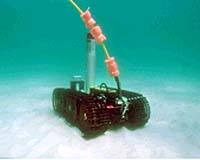
Waltham - Jul 7, 2003 It can follow a search instruction plan, classify, and map underwater mines in turbulent ocean surf zones. It travels about 6 feet per second on land, and about 2 feet per second in the water. It avoids obstacles. These 90-lb, fully autonomous amphibious reconnaissance vehicles may look like no more than overgrown remotely operated toy tanks, but they have been used to search under the World Trade Center after 9/11, to search Afghan caves, to look at underwater wreckage off Normandy's beaches, and several are now currently deployed in Iraq. Funded by Tom Swean at the Office of Naval Research, the Surf Zone Crawlers are being built for the Navy by Foster-Miller, Inc. in Waltham, MA in partnership with the Naval Coastal Systems Station as one possible answer to the perennial problem of bottom mine detection in very shallow waters and the surf zone. It is based on a platform by Foster-Miller called the Tactical Adaptable Robot, which operates on land. The underwater concept � now called the Surf Zone Crawler � is to release one or many crawlers to search predetermined regions of the sea bottom, and to determine whether an area is mined or not and what type of threat exists. Then, Reacquisition-Identification-Neutralization (RIN) missions can be performed using these bottom-crawling robots. "The key components of underwater robotic reconnaissance," says Swean, "are search and area coverage, sensing and discrimination of bottom objects, communications, and the autonomous control of single as well as multiple platforms. "The goal is to use these robots to exhaustively scout and map potential approach lanes for amphibious naval operations. Control, navigation, communication, and sensor payload are the key issues." "Each of these robots carries a suite of sensors to detect mines and obstacles and reject clutter," says Mitch Gavrilash at the Naval Sea Systems Command's Naval Coastal Systems Station in Panama City, FL. "When it detects what it determines is a threat object, it reports to a remote human operator and provides an image for identification." The maps and images are then stored electronically for future avoidance or neutralization missions. The Surf Zone Crawler can be configured with various battery, sensor and payload options, such as sonars, cameras, metal detectors, tactile sensors (they know what they bump into once they bump into it), and in the near future, chemical-biological sensors. It operates for 4 -6 hours on lithium batteries, and can travel about 7 nautical miles in water during that time. The longer range goal of this research is to develop teams of robots to work cooperatively together to hunt and neutralize mines. "Communication bandwidth is a real issue, as is the interoperability of several crawlers working together, says Swean. "It's one thing to communicate above water � that's fairly simple � but it's quite another to do it underwater. Acoustic modems are being developed, but they can only send a limited amount of information. This is our current challenge." Community Email This Article Comment On This Article Related Links Office of Naval Research SpaceDaily Search SpaceDaily Subscribe To SpaceDaily Express All about the robots on Earth and beyond!
 Engineers Deliver Robot to Neutralize Remote Explosives
 Tyndall AFB (SPX) Jun 30, 2005
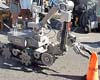
Engineers from the Air Force Research Laboratory Materials and Manufacturing Directorate have rapidly prototyped, developed, and delivered low-cost expendable robots to disable and dispose of improvised explosive devices. |
|
|

| The content herein, unless otherwise known to be public domain, are Copyright 1995-2006 - SpaceDaily.AFP and UPI Wire Stories are copyright Agence France-Presse and United Press International. ESA PortalReports are copyright European Space Agency. All NASA sourced material is public domain. Additionalcopyrights may apply in whole or part to other bona fide parties. Advertising does not imply endorsement,agreement or approval of any opinions, statements or information provided by SpaceDaily on any Web page published or hosted by SpaceDaily. Privacy Statement |