|
 |
 |
 |
 |
 |
 |
 |
 |

 |
Crash Boom Bang And How To Walk Away
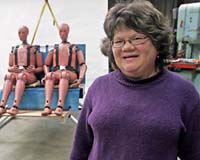
Hampton VA (SPX) Jan 30, 2007 She's no comic book author, but a NASA senior research engineer looking for ways to improve aircraft and spacecraft. Jackson has studied materials, structural designs that can better absorb energy, and crash simulations for 25 years -- first for the Army and now for NASA. She works at what is now the Landing Impact Research at NASA's Langley Research Center in Hampton, Va. Recently she shared some of what she has learned when the NASA TV education channel broadcast "Crash Safety: Past Success and Future Concepts," one in a series of Aeronautics Research Mission Directorate (ARMD) technical seminars. "I work at a very unique facility at NASA Langley," said Jackson. "It's a steel A-frame gantry that's about 240 feet high, 400 feet long and 265 feet wide at the base." The gantry, which looks a lot like a huge red and white erector set, started out its life in the early 1960s as the place where Neil Armstrong and 23 other astronauts learned to land on the moon. Once the Apollo program was over, the lunar landing research facility transformed into an aircraft crash test site -- the only one in this country that can swing a full-sized plane or helicopter into the ground like a pendulum, simulating real life accident conditions. "The goal of any research program that has an element of impact dynamics is to develop a fundamental understanding of the crash response of aerospace vehicles," said Jackson. "Then once we understand that response we can look at ways to improve the crash performance of that particular vehicle." Over the last 35 years researchers at NASA Langley have dropped dozens of small airplanes, military aircraft or aircraft components to test materials, structures and systems that can help save lives and reduce injuries in the event of an accident. On board the aircraft in many of the drops were crash test dummies acting as passengers and crew. "We often have quite a lot of instrumentation on these tests, typically on the order of 100-200 channels of data, collecting about 10,000 samples per second," said Jackson. "We have a large number of external cameras, video cameras, high speed film cameras and we have cameras on board to see how the seats are responding and the occupants." Recently, with NASA's renewed emphasis on returning to the Moon and going on to Mars and beyond, Jackson and her colleagues have spent a lot of time testing models of the Orion capsule, the next U.S. spaceship for human exploration. "We're looking at flexible models," said Jackson. "We hope we will also be able to look at an integrated, fully flexible model of the command module that includes dummies, seats, restraints and any external energy absorbing devices that might be used." NASA Langley impact dynamics specialists are also studying new materials and systems that might be added to space capsules and other air vehicles to help them land safely. Researchers say the last few minutes of any spaceflight -- the entry, descent and landing -- are some of the most challenging. That was the topic of the one technical seminar. Other subjects include air traffic management automation concepts, thermal protection systems for hypersonic vehicles and pilot training and other improvements to help airliners recover from steep dives or other upset conditions. Community Email This Article Comment On This Article Related Links All about the technology of space and more Space Technology News - Applications and Research
 New Approaches For Producing Large Composite Structures
 New Orleans LA (SPX) Jan 23, 2007
Northrop Grumman has teamed up with the University of New Orleans' National Center for Advanced Manufacturing (NCAM) to develop and test new ways to produce large composite structures that NASA could use to create future space transportation systems. |
|
|

| The content herein, unless otherwise known to be public domain, are Copyright 1995-2006 - SpaceDaily.AFP and UPI Wire Stories are copyright Agence France-Presse and United Press International. ESA PortalReports are copyright European Space Agency. All NASA sourced material is public domain. Additionalcopyrights may apply in whole or part to other bona fide parties. Advertising does not imply endorsement,agreement or approval of any opinions, statements or information provided by SpaceDaily on any Web page published or hosted by SpaceDaily. Privacy Statement |