|
 |
 |
 |
 |
 |
 |
 |
 |

 |
Countdown begins for Australian satellite
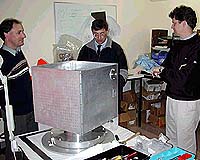
Canberra - Nov 26, 2002 Australia's experimental satellite FedSat has been successfully attached to the rocket from which it will be released into space in three weeks time. Engineers of the Cooperative Research Centre for Satellite Systems (CRCSS), which built the satellite in Canberra, finished preparatory work with staff of the National Space Development Agency of Japan (NASDA) at the Tanegashima Space Centre, about 1000 km south west of Tokyo. FedSat will be one of four satellites to be placed into orbit by the H-IIA launch vehicle, in its fourth launch. In an agreement signed in September, NASDA will launch FedSat in exchange for scientific data from the Australian research mission. The satellite was shipped to the launch site two weeks ago and CRCSS staff carried out the final preparatory tests. The satellite will be controlled from a ground station in Adelaide, with the first signals expected about ten hours after launch on 14 December. The FedSat microsatellite project commenced in 1998, and is designed to demonstrate Australia's capability to design, build and operate small satellites. The spacecraft will carry advanced communication, space science, navigation and computing payloads. Data from the scientific payloads will contribute to international research programs, and to the research projects of up to 100 graduate students and staff of the Centre. FedSat is the first satellite built in Australia since WRESAT and Oscar V in the period 1967-1970. The satellite was built by a team of about 15 engineers and scientists at the CRCSS Project Office at Auspace Limited in Mitchell, a suburb of Canberra. Most of the payloads were developed in other CRCSS laboratories in NSW, Queensland and South Australia. The United States National Aeronautics and Space Administration supplied one payload. The Australian Government earlier this month issued an Overseas Launch Certificate for FedSat, under the terms of the Space Activities Act 1998. The H-IIA rocket, over 53 m tall, is able to carry up to 6 tonnes into geostationary orbit, and a larger amount into lower orbits. It is powered by solid-fuel strap on boosters and cryogenic main engines burning liquid hydrogen and oxygen. The two-stage rocket is about the same length as the Space Shuttle and is Japan's indigenous launch vehicle. It operates from the Yoshinobu Launch Range at Tanegashima Space Centre, on the island of Tanegashima. Since 1975, nearly forty satellites have been launched from the Centre. The third flight of the H-IIA was carried out successfully from Tanegashima on 10 September, carrying two payloads into geostationary orbit. FedSat will be launched into low Earth orbit at about 800 km altitude. Japan's Advanced Earth Observing Satellite ADEOS-II and two Japanese micro-satellites will be launched on the same flight. Community Email This Article Comment On This Article Related Links FedSat Launch of H-IIA Flight 3 SpaceDaily Search SpaceDaily Subscribe To SpaceDaily Express Microsat News and Nanosat News at SpaceMart.com
 Small Satellite Solutions From Scotland
 Clyde, Scotland (SPX) Jan 12, 2006
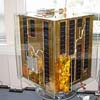
Clyde Space are offering the growing ranks of small satellite manufacturers power subsystem solutions for their missions. Based in purpose built facilities on West of Scotland Science Park in Glasgow, Clyde Space has a range of power subsystems for missions from as little as 1W up to in excess of 2.5kW. |
|
|

| The content herein, unless otherwise known to be public domain, are Copyright 1995-2006 - SpaceDaily.AFP and UPI Wire Stories are copyright Agence France-Presse and United Press International. ESA PortalReports are copyright European Space Agency. All NASA sourced material is public domain. Additionalcopyrights may apply in whole or part to other bona fide parties. Advertising does not imply endorsement,agreement or approval of any opinions, statements or information provided by SpaceDaily on any Web page published or hosted by SpaceDaily. Privacy Statement |