|
 |
 |
 |
 |
 |
 |
 |
 |

 |
Cospas-Sarsat Now Relaying Alerts From MSG-1 Weather Satellite
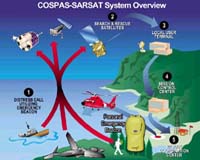
Paris - Nov 27, 2003 The MSG-1 European weather satellite orbited by an Ariane 5 launcher in August 2002 and operated by Eumetsat is carrying a 406-MHz transponder for the COSPAS-SARSAT international search-and-rescue system. The COSPAS-SARSAT French mission control centre (FMCC) at the Toulouse Space Centre began relaying alert signals from this transponder on 26 August 2003. With this new capability, Europe is helping to complete the system's global geostationary coverage, which has been provided until now by two U.S. GOES satellites and India's INSAT-3 satellite. Launching 406-MHz transponders on geostationary satellites to relay distress signals from COSPAS-SARSAT emergency beacons has considerably enhanced search-and-rescue service. The main advantage of having transponders in geostationary orbit lies in their ability to complement the service already delivered by the seven non-synchronous satellites operating within the COSPAS-SARSAT programme. The latter detect signals from beacons within one-and-a-half hours at most, whereas geostationary satellites can relay signals from within their coverage area in under five minutes. This means rescue teams can reach distress callers more quickly and increase their chances of survival. Until now, the Indian Ocean has been covered by India's INSAT-3 satellite, and the Atlantic and Pacific Oceans by the U.S. GOES satellites. Thanks to a 406-MHz transponder on the MSG-1 weather satellite operated by Eumetsat, Europe is now fully covered too. Since 26 August 2003, the FMCC has been distributing alert data relayed by MSG-1 from a geostationary Earth-orbit local user terminal (GEOLUT) at CNES's Toulouse Space Centre. Two other terminals in the Canary Islands and the United Kingdom are set to start providing the same service in the coming months. The COSPAS-SARSAT programme has played a crucial role in saving more than 15,000 lives since 1982. It is a superb feat of engineering and an exemplary international cooperative programme. The system is operated in close partnership between CNES and the user authorities: the French civil aviation authority DGAC and the French maritime and seafaring affairs authority DAMGM. Three receiving stations and a mission control centre are located at the Toulouse Space Centre, where operators receive distress calls round the clock and relay them to rescue coordination centres. Under an intergovernmental agreement signed in 1988, the COSPAS-SARSAT programme initiated in 1982 is run by the four founding nations (United States, Canada, Russia and France), which supply the spaceborne equipment, supported by 33 participating nations, some of which supply elements of the system's ground segment. The seven non-synchronous satellites currently used are five U.S. SARSAT satellites operated by NOAA (carrying 406-MHz instruments supplied by CNES) and two Russian COSPAS satellites, now operating alongside four transponders in geostationary orbit. Community Email This Article Comment On This Article Related Links Centre National d'Etudes Spatiales SpaceDaily Search SpaceDaily Subscribe To SpaceDaily Express Earth Observation News - Suppiliers, Technology and Application
 New Legislation Initiated To Support Commercial Remote Sensing Industry
 New York NY (SPX) Jan 11, 2006
The importance of remotely sensed data and technologies to support natural disasters has prompted attention and action in Washington. New initiatives and legislation authorizing appropriations to the remote sensing industry will be discussed at Strategic Research Institute's U.S. Commercial Remote Sensing Industry conference, scheduled for February 9-10, 2006 in Washington D.C. |
|
|

| The content herein, unless otherwise known to be public domain, are Copyright 1995-2006 - SpaceDaily.AFP and UPI Wire Stories are copyright Agence France-Presse and United Press International. ESA PortalReports are copyright European Space Agency. All NASA sourced material is public domain. Additionalcopyrights may apply in whole or part to other bona fide parties. Advertising does not imply endorsement,agreement or approval of any opinions, statements or information provided by SpaceDaily on any Web page published or hosted by SpaceDaily. Privacy Statement |