|
 |
 |
 |
 |
 |
 |
 |
 |

 |
Cosmos 1 Hardware Continues to Pass Tests
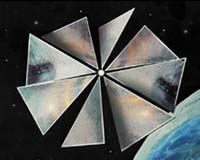
Miass - Jul 25, 2003 This past month, the first two stages of the Volna launch vehicle passed their re-qualification tests with our solar sail spacecraft. At the Makeev Rocket Design Bureau in Miass, Russia, the Cosmos 1 engineering model underwent vibration and other dynamical tests to simulate launch during the firing of the first and second Volna stages. The critical payload separation from the third stage will be tested in the last week of July in Miass. It was at this point during our test flight in July 2001 that the rocket failed. The payload prematurely separated from the third stage, when the latter was separating from the second stage on two sub-orbital missions in the past two years. The first was our solar sail deployment test; the second carried a European payload designed to test an inflatable re-entry and descent vehicle. This test of the reworked separation sequence will be a critical milestone for launch vehicle readiness. The test will be conducted from a 60-meter drop tower in a vacuum. The separation test will simulate zero-g and vacuum space conditions. The dropped spacecraft model will be caught before it hits the ground so that it will not be damaged. Then it will be returned to the Babakin Space Center in Moscow for final assembly and testing. The team will fit the spacecraft with new solar sail blades and the solar power array will be modified before the final flight model will be ready. Electronics testing at the Space Research Institute also continues, but its progress has been somewhat slower. Every step of the complex software controlling spacecraft operations needs to be checked. The central computer has passed nearly all tests involved in the "nominal" sequence, but it must also be tested for many non-nominal situations. {"Nominal" is a very popular word with space engineers meaning, "the way things are supposed to work if nothing goes wrong." In space, not much happens nominally.) The S-band radio system is still not complete, although an engineering model was delivered and tested in the past couple of weeks. The software for some of the sensors, including a GPS navigation system, is also not yet complete. We could conduct the mission without completing every part of the software, and even without the S-band receiver and GPS system. But at a recent meeting, the Russian and American engineers unanimously affirmed the opinion that we should allow the schedule to slip rather than increase mission risk. We will, as we have repeatedly said, launch when ready. Still, we would like to launch before the end of October. In November or December, the Russian navy will be conducting other operations in the Severomorsk launch area near Murmansk, and we will not be able to use that area for our launch from a submarine. (This would not be a great sacrifice. I don't think anyone on our team actually wants to be north of the Arctic Circle in that time of year.) Despite the schedule slips, the Cosmos 1 spacecraft is coming along very well, and our project goals remain firm. Our next big milestone will be the drop test of the third stage separation at the end of July. After that, probably at the end of August, we will hold a spacecraft readiness review. And then, perhaps, we will set the date to launch Cosmos 1, the first solar sail. Community Email This Article Comment On This Article Related Links Solar Sail at Planetary Society SpaceDaily Search SpaceDaily Subscribe To SpaceDaily Express Space Technology News - Applications and Research
 TeleRay Mobile Sat TV Antenna For Japan Auto Market
 Las Vegas CA (SPX) Jan 5, 2006
RaySat has introduced TeleRay, the world's smallest satellite TV vehicle antenna, into the domestic Japanese automotive market. |
|
|

| The content herein, unless otherwise known to be public domain, are Copyright 1995-2006 - SpaceDaily.AFP and UPI Wire Stories are copyright Agence France-Presse and United Press International. ESA PortalReports are copyright European Space Agency. All NASA sourced material is public domain. Additionalcopyrights may apply in whole or part to other bona fide parties. Advertising does not imply endorsement,agreement or approval of any opinions, statements or information provided by SpaceDaily on any Web page published or hosted by SpaceDaily. Privacy Statement |