|
 |
 |
 |
 |
 |
 |
 |
 |

 |
Cosmic Magnifying Glass: Distant Star Reveals Planet
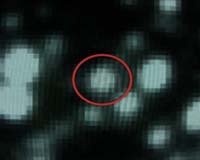
Pasadena - Apr 16, 2004 Like Sherlock Holmes holding a magnifying glass to unveil hidden clues, modern day astronomers used cosmic magnifying effects to reveal a planet orbiting a distant star. This marks the first discovery of a planet around a star beyond Earth's solar system using gravitational microlensing. A star or planet can act as a cosmic lens to magnify and brighten a more distant star lined up behind it. The gravitational field of the foreground star bends and focuses light, like a glass lens bending and focusing starlight in a telescope. Albert Einstein predicted this effect in his theory of general relativity and confirmed it with our sun. "The real strength of microlensing is its ability to detect low-mass planets," said Dr. Ian Bond of the Institute for Astronomy in Edinburgh, Scotland, lead author of a paper appearing in the May 10 Astrophysical Journal Letters. The discovery was made possible through cooperation between two international research teams: Microlensing Observations in Astrophysics (MOA) and Optical Gravitational Lensing Experiment (OGLE). Well-equipped amateur astronomers might use this technique to follow up future discoveries and help confirm planets around other stars. The newly discovered star-planet system is 17,000 light years away in the constellation Sagittarius. The planet, orbiting a red dwarf parent star, is most likely one-and-a- half times bigger than Jupiter. The planet and star are three times farther apart than Earth and the sun. Together, they magnify a farther, background star some 24,000 light years away, near the Milky Way center. In most prior microlensing observations, scientists saw a typical brightening pattern, or light curve, indicating a star's gravitational pull was affecting light from an object behind it. The latest observations revealed extra spikes of brightness, indicating the existence of two massive objects. By analyzing the precise shape of the light curve, Bond and his team determined one smaller object is only 0.4 percent the mass of a second, larger object. They concluded the smaller object must be a planet orbiting its parent star. Dr. Bohdan Paczynski of Princeton University, Princeton, NJ, an OGLE team member, first proposed using gravitational microlensing to detect dark matter in 1986. In 1991, Paczynski and his student, Shude Mao, proposed using microlensing to detect extrasolar planets. Two years later, three groups reported the first detection of gravitational microlensing by stars. Earlier claims of planet discoveries with microlensing are not regarded as definitive, since they had too few observations of the apparent planetary brightness variations. "I'm thrilled to see the prediction come true with this first definite planet detection through gravitational microlensing," Paczynski said. He and his colleagues believe observations over the next few years may lead to the discovery of Neptune-sized, and even Earth-sized planets around distant stars. Microlensing can easily detect extrasolar planets, because a planet dramatically affects the brightness of a background star. Because the effect works only in rare instances, when two stars are perfectly aligned, millions of stars must be monitored. Recent advances in cameras and image analysis have made this task manageable. Such developments include the new large field-of-view OGLE-III camera and the MOA-II 1.8 meter (70.8 inch) telescope being built and cooperation between microlensing teams. "It's time-critical to catch stars while they are aligned, so we must share our data as quickly as possible," said OGLE team-leader Dr. Andrzej Udalski of Poland's Warsaw University Observatory. Udalski in Poland and Paczynski in the U.S lead the Polish/American project. It operates at Las Campanas Observatory in Chile, run by the Carnegie Institution of Washington, and includes the world's largest microlensing survey on the 1.3 meter (51-inch) Warsaw Telescope. Community Email This Article Comment On This Article Related Links SpaceDaily Search SpaceDaily Subscribe To SpaceDaily Express Nuclear Space Technology at Space-Travel.com
 Carina Nebula Dust Pillars Harbor Embedded Stars
 Boulder CO (SPX) May 31, 2005
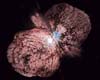
Astronomers using NASA's Spitzer Space Telescope have imaged a giant molecular cloud being shredded by howling stellar winds and searing radiation, exposing a group of towering dust pillars harboring infant stars, according to a University of Colorado at Boulder researcher. |
|
|

| The content herein, unless otherwise known to be public domain, are Copyright 1995-2006 - SpaceDaily.AFP and UPI Wire Stories are copyright Agence France-Presse and United Press International. ESA PortalReports are copyright European Space Agency. All NASA sourced material is public domain. Additionalcopyrights may apply in whole or part to other bona fide parties. Advertising does not imply endorsement,agreement or approval of any opinions, statements or information provided by SpaceDaily on any Web page published or hosted by SpaceDaily. Privacy Statement |