|
 |
 |
 |
 |
 |
 |
 |
 |

 |
Cosmic Cockroaches
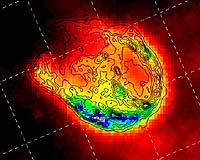
Boston MA (SPX) Sep 07, 2007 Starved. Stomped. Radiated. Poisoned. It's all in a day's work for the common household cockroach. The abuse these creatures can withstand is amazing. But astronomers have found something even tougher-"polycyclic aromatic hydrocarbons," says Achim Tappe of the Harvard Center for Astrophysics. "They can survive a supernova." Polycyclic aromatic hydrocarbons (PAHs for short) are ring-shaped molecules made of carbon and hydrogen. They're about as well loved as roaches: PAHs are a widespread organic pollutant, appearing in auto exhaust, oil spills and cigarette smoke. The EPA has classified seven PAH compounds as human carcinogens. But even PAHs have their virtues: Ring-shaped molecules similar to PAHs are found in DNA, and there's a growing consensus among biologists that PAHs were present on Earth 4.5 billion years ago when life began. By serving as building blocks for larger molecules of life, PAHs may have played an essential role in the chemical process of genesis. That's why Tappe's recent discovery may be so important. The story begins 3000 years ago when a massive star in the Large Magellanic Cloud exploded. It was, in most respects, a typical supernova explosion, releasing in a just few days the energy our sun produces in about 10 billion years. Hot gas and deadly radiation blasted through nearby star systems, while the exploding star itself was mostly (and perhaps completely) destroyed. The supernova's expanding shell, catalogued by astronomers as "N132D", remains visible from Earth after all these years. It spans 80 light years and has swept up some 600 Suns worth of mass. Images from the Chandra X-ray Observatory reveal the still-hot outlines--see the diagram below. Last year "we scanned N132D using the Spitzer Space Telescope," says Tappe. Spitzer is an infrared (IR) telescope, and it has a spectrometer onboard sensitive to the IR emissions of PAHs. One look at N132D revealed "PAHs all around the supernova's expanding shell. They appear to be swept up by a shock wave of 8 million degree gas. This is causing some damage to the molecules, but many of the PAHs are surviving." Below: Supernova remnant N132D. Contours trace hot gas observed by the Chandra X-ray Observatory. Colors denote IR radiation mapped by the Spitzer Space Telescope. Image credit: Achim Tappe and colleagues. Astronomers have long known that PAHs are abundant not only on Earth but throughout the cosmos-they've been found in comet dust, meteorites and many cold interstellar clouds-but who knew they were so tough? "This is our first evidence that PAHs can withstand a supernova blast," he says. Their ability to survive may be key to life on Earth. Many astronomers are convinced that a supernova exploded in our corner of the galaxy 4-to-5 billion years ago just as the solar system was coalescing from primitive interstellar gas. In one scenario of life's origins, PAHs survived and made their way to our planet. It turns out that stacks of PAHs can form in water-think, primordial seas-and provide a scaffold for nucleic acids with architectural properties akin to RNA and DNA. "It's an exciting and promising theory," says Tappe. "But more experiments and observations are needed to decide its ultimate success or failure." Tappe is doing his part with a new round of Spitzer observations: "We're mapping the distribution of PAHs around N132D, comparing the locations of the molecules to the arc of shock waves revealed by Chandra," he explains. From this "we hope to learn how PAHs are 'processed' by the blast, and how many survive." In the end, PAHs may prove tough enough for genesis itself. Cockroaches, eat your hearts out. Community Email This Article Comment On This Article Related Links Science@NASA Chandra X-ray Observatory Spitzer Space Telescope Stellar Chemistry, The Universe And All Within It
 Hubble And Spitzer Space Telescopes Find Lego-Block Galaxies In Early Universe
 Pasadena CA (SPX) Sep 07, 2007
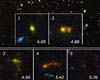
NASA's Hubble and Spitzer Space Telescopes have joined forces to discover nine of the smallest, faintest, most compact galaxies ever observed in the distant universe. Blazing with the brilliance of millions of stars, each of the newly discovered galaxies is a hundred to a thousand times smaller than our Milky Way Galaxy. "These are among the lowest mass galaxies ever directly observed in the early universe" says Nor Pirzkal of the Space Telescope Science Institute in Baltimore, Md. |
|
|

| The content herein, unless otherwise known to be public domain, are Copyright 1995-2007 - SpaceDaily.AFP and UPI Wire Stories are copyright Agence France-Presse and United Press International. ESA Portal Reports are copyright European Space Agency. All NASA sourced material is public domain. Additional copyrights may apply in whole or part to other bona fide parties. Advertising does not imply endorsement,agreement or approval of any opinions, statements or information provided by SpaceDaily on any Web page published or hosted by SpaceDaily. Privacy Statement |