|
 |
 |
 |
 |
 |
 |
 |
 |

 |
Corridors Of Power Iran Defies IAEA
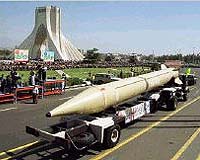
UPI Chief International Correspondent Washington DC (UPI) Feb 13, 2006 The Bush administration has never been able to buttress its warnings of Iran's nuclear ambitions with an accurate assessment of how close to their goal the Iranians really are, and recent remarks by two senior officials shed little light on that key question. U.S. Undersecretary of State for Arms Control Robert Joseph, considered a leading defense hawk, came closer than anyone before to saying that Iran was on the verge of becoming a nuclear power. "I would say that Iran does have the capability to develop nuclear weapons and the delivery means for those weapons," Joseph said. "We have watched Iran proceed step by step, conversion to enrichment-related activities, in a way that demonstrated very clearly that they are moving forward to a nuclear weapons capability." But on his first appearance before the Senate Intelligence Committee as director of National Intelligence last week, John Negroponte was more circumspect. "Tehran probably does not have a nuclear weapon and has not yet produced or acquired the necessary fissile material," he said. However, he went on, "the danger that it will acquire a nuclear weapon, and the ability to integrate it with the ballistic missiles Iran already possesses, is a reason for immediate concern." The concern was heightened Monday when (a) there were reports that the Iranians had resumed some uranium enrichment work at the Natanz plant in defiance of the recent call by the International Atomic Energy Agency to freeze its nuclear program; and (b) Tehran postponed a meeting in Moscow to discuss a Russian compromise proposal whereby Iran's nuclear fuel would be produced in Russia which would ensure closer control on its use. The reports of Iran picking up where it left off three years ago when Tehran voluntarily halted nuclear development during talks with three European Union governments quoted diplomats in Vienna, Austria, where the IAEA, the U.N.'s nuclear watchdog, has its headquarters. But an IAEA spokesperson told United Press International: "We're not in a position at this point to confirm whether the Iranians have begun the enrichment process, but we will have inspectors there soon." As for the Moscow meeting, which had been scheduled for Thursday, Iranian and Russian sources both said that although it was postponed, the Iranians have not rejected the Russian offer. Talks could be restarted "by mutual agreement," according to a spokesman in Tehran, Gholamhossein Elham. IAEA sources said Natanz is a pilot scheme monitored by IAEA inspectors, and although capable of processing uranium hexofluoride gas into enriched uranium would not turn out enough for weapons manufacture. Even so, the IAEA resolution of Feb. 4 called on Iran to "re-establish full and sustained suspension of all enrichment-related and reprocessing activities" and the Iranians seemed Monday to have done the opposite. Iran has until early March to pull back from the brink, when the IAEA governing council convenes to hear Director General Mohamed ElBaradei's report on the situation before he forwards it to the U.N. Security Council. Iran has been under threat of U.N. action since September when the IAEA found it was not complying with the Nuclear Non-Proliferation Treaty. The United States and the European Union are concerned that Iran's nuclear program is a front for developing nuclear weapons: the Iranians insist that what they are after is civil nuclear power. But Iran has sent conflicting signals about its intentions, making it hard to determine what it really wants, and where it is going. On Saturday, typically, Iranian President Mahmoud Ahmadinejad threatened Iran's withdrawal from the Nuclear Proliferation Treaty because the international community refused to recognize his country's right to develop a nuclear program. "There is no reason to continue our current nuclear policy while we are deprived of the positive aspects of the treaty," he said. But on Sunday, Foreign Minister Manouchehr Mottaki expressed his support for the NPT, indirectly contradicting his president. The United States agreed to holding off sending the report to the Security Council until March instead of immediately after the earlier governors' meeting on Feb. 4 in order to win more member support for transferring the issue to the United Nations, according to Washington diplomatic sources. The ostensible argument for postponement was to give the Iranians more time to contemplate the consequences of their intentions. But another possible ploy for keeping the issue out of the Security Council in February was the fact that Washington's Representative to the United Nations, John Bolton, who holds tough views on how to deal with Iran's intransigence, is this month's council president, a post that rotates among the 15 members. In March, the presidency passes to the ambassador from Argentina -- and hopefully less danger of a confrontational outcome.
Source: United Press International Community Email This Article Comment On This Article Related Links - Learn about nuclear weapons doctrine and defense at SpaceWar.com Learn about missile defense at SpaceWar.com All about missiles at SpaceWar.com Learn about the Superpowers of the 21st Century at SpaceWar.com
 Irans Shihab3 Fails Test Launch
 Washington DC (UPI) Feb 15, 2006
An Iranian test launch of a Shihab-3 intercontinental ballistic missile Jan. 17 ended in failure, FlightInternational.com reported Tuesday. However, Western sources told the British-based magazine and Web site that Iran was still making significant progress towards its target of developing an operational capability to strike targets in mainland Europe. |
|
|

| The content herein, unless otherwise known to be public domain, are Copyright 1995-2006 - SpaceDaily.AFP and UPI Wire Stories are copyright Agence France-Presse and United Press International. ESA PortalReports are copyright European Space Agency. All NASA sourced material is public domain. Additionalcopyrights may apply in whole or part to other bona fide parties. Advertising does not imply endorsement,agreement or approval of any opinions, statements or information provided by SpaceDaily on any Web page published or hosted by SpaceDaily. Privacy Statement |