|
 |
 |
 |
 |
 |
 |
 |
 |

 |
Cornell Researchers Develop Virus-Size Nanolamps
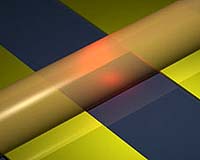
Ithica NY (SPX) Apr 12, 2007 To help light up the nanoworld, a Cornell interdisciplinary team of researchers has produced microscopic "nanolamps" -- light-emitting nanofibers about the size of a virus or the tiniest of bacteria. In a collaboration of experts in organic materials and nanofabrication, researchers have created one of the smallest organic light-emitting devices to date, made up of synthetic fibers just 200 nanometers wide (1 nanometer is one-billionth of a meter). The potential applications are in flexible electronic products, which are being made increasingly smaller. The fibers, made of a compound based on the metallic element ruthenium, are so small that they are less than the wavelength of the light they emit. Such a localized light source could prove beneficial in applications ranging from sensing to microscopy to flat-panel displays. The work, published in the February issue of Nano Letters, was a collaboration of nine Cornell researchers, including first author Jose M. Moran-Mirabal, an applied physics Ph.D. student; Hector Abruna, the E.M. Chamot Professor of Chemistry and Chemical Biology; George Malliaras, associate professor of materials science and engineering and director of the Cornell NanoScale Facility; and Harold Craighead, the C.W. Lake Jr. Professor of Engineering and director of the National Science Foundation-funded Nanobiotechnology Center. Using a technique called electrospinning, the researchers spun the fibers from a mixture of the metal complex ruthenium tris-bipyridine and the polymer polyethylene oxide. They found that the fibers give off orange light when excited by low voltage through micro-patterned electrodes -- not unlike a tiny light bulb. "Imagine you have a light bulb that is extremely small," said Malliaras, an organic materials expert. "Then you can use the bulb to illuminate objects that you wouldn't be able to see otherwise." Craighead's research group, which focuses on nanostructures and devices, supplied the expertise on the electrospinning technique. The technique, explained Moran-Mirabal, who works in Craighead's laboratory, can be compared with pouring syrup on a pancake on a rotating table. As the syrup is poured, it forms a spiraling pattern on the flat pancake, which in electrospinning is the substrate with micropatterned gold electrodes. The syrup would be the solution containing the metal complex-polymer mixture in solvent. A high voltage between a microfabricated tip and the substrate ejects the solution from the tip, Moran-Mirabal said, and forms a jet that is stretched and thinned. As the solvent evaporates, the fiber hardens, laying down a solid fiber on the substrate. As scientists look for ways to innovate -- and shrink -- electronics, there is much interest in organic light-emitting devices because they hold promise for making panels that can emit light but are also flexible, said Moran-Mirabal. "One application of organic light-emitting devices could be integration into flexible electronics," he said. The research also shows that these tiny light-emission devices can be made with simple fabrication methods. Compared with traditional methods of high-resolution lithography, in which devices are etched onto pieces of silicon, electrospinning requires almost no fabrication and is simpler to do. The durability of organic electronics is still under investigation, and this recently completed research is no exception, Craighead said. "The current interest is in the ease with which this material can be made into very small light-emitting fibers," he said. "Its ultimate utility, I think, will depend on how well it stands up to subsequent processing and use." Other co-authors on the work are graduate students Jason D. Slinker, John A. DeFranco, Scott S. Verbridge, Samuel Flores-Torres and CNF staff member Rob Ilic. Community Email This Article Comment On This Article Related Links Cornell Chronicle Online Home Page Nano Technology News From SpaceMart.com Nano Technology News From SpaceMart.com Computer Chip Architecture, Technology and Manufacture
 ORNL Helps Develop Next-Generation LEDs
 Oak Ridge TN (SPX) Mar 28, 2007
Nanotechnology may unlock the secret for creating highly efficient next-generation LED lighting systems, and exploring its potential is the aim of several projects centered at Oak Ridge National Laboratory. |
|
|

| The content herein, unless otherwise known to be public domain, are Copyright 1995-2006 - SpaceDaily.AFP and UPI Wire Stories are copyright Agence France-Presse and United Press International. ESA PortalReports are copyright European Space Agency. All NASA sourced material is public domain. Additionalcopyrights may apply in whole or part to other bona fide parties. Advertising does not imply endorsement,agreement or approval of any opinions, statements or information provided by SpaceDaily on any Web page published or hosted by SpaceDaily. Privacy Statement |