|
 |
 |
 |
 |
 |
 |
 |
 |

 |
Corn Fungus Is Nature's Master Blaster
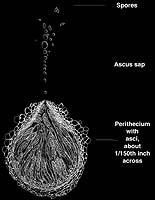
Durham NC (SPX) Jul 26, 2005 Biologists have discovered that a common corn fungus is by far nature's most powerful known cannoneer, blasting its spores out with a force of 870,000 times the force of gravity. Farmers need not worry about being nailed by a fungal supergun, however. The infinitesimal spore travels only two-tenths of an inch (5 millimeters) before plummeting. Nevertheless, said the biologists, the fungus Gibberella zeae outguns the previous record holder, the fungus Pilobolus, by almost a hundred-fold. It also outperforms a rifle, which launches its bullet with less than one-tenth that acceleration. The researchers -- Frances Trail and Iffa Gaffoor of Michigan State University, and Steven Vogel of Duke University -- published their findings in the June 2005 issue of Fungal Genetics and Biology. The study was supported by the U.S. Department of Agriculture and the Michigan Agricultural Experiment Station. According to Vogel, the "bioballistics" of the fungus offers a dramatic lesson in the physics of scaling. At the infinitesimal scale of the fungus' spore, atmospheric drag plays an enormous role -- hence the need for an extremely high ejection speed to achieve even the most modest dispersal of its spore. "To get a literal feel for a world in which drag makes more impact than does gravity, just inflate a six-inch balloon and throw it as hard as you can," said Vogel. The purpose of the study that revealed the fungus's extraordinary launch capabilities was to better understand the biological mechanism behind the fungal supergun. Basically, the gun is powered by the buildup of pressure inside the spore-containing fungal fruiting body, called the perithecium, due to the ability of sap to create an osmotic pressure. Such pressure is due to water flowing across a membrane into the perithecium as it tries to equalize the concentration of a salt solution inside the chamber. In the case of the fungus, at question was whether the sugar mannitol or potassium ions were responsible for the osmotic pressure that generated the propulsive force. In their experiments, Trail and Gaffoor created a fungal "shooting gallery" consisting of a small glass chamber, in which they mounted a block of gel-like agar containing mature perithecia. They arranged the agar so that the perithecia would launch their spores onto a removable glass cover slip. The researchers measured the length of the fungal blasts and calculated the mass of the spore. That mass turned out to be very low for a fungal spore, explaining why the fungus could achieve such extraordinary launch speeds, said Vogel. He fed data from the laboratory experiments and spore mass calculations into a computer program he had developed to determine the ballistics of such projectiles. One result was the record acceleration of 870,000 times gravity for the spores and a launch speed of nearly 80 miles an hour. The analysis of the fungal shooting ability led the biologists to determine that the osmotic pressure from potassium, and not the mannitol, likely generated the force necessary for the powerful blast. Vogel said he originally created the bioballistics program to demonstrate to his undergraduate classes how drag and other factors affect the trajectories of natural projectiles -- from kangaroo rats to locusts to fleas to fungal spores. "The big animals aren't so interesting in terms of drag," said Vogel. "But when you get down to a flea, it loses about eighty percent of potential range to drag. And the optimum launch angle gets lower. "In physics class, people are taught that the best angle is forty-five degrees, but when drag is bad, the angle needs to be lower -- you want to achieve some distance while you still have decent speed. Altitude no longer gives much advantage. Thus, in the fungus the launch angle is barely above horizontal," he said. "An obvious question is why the fungus even bothers. Given the short range of its spores, why bother accelerating to eighty miles per hour to go a mere five millimeters?," said Vogel. "Since there is almost no air movement at the surface where the spore grows, the real object of the launch is to get the spore even a little ways from the parent, so that it can get into air currents, which will really give the spore some range." Community Email This Article Comment On This Article Related Links Duke University SpaceDaily Search SpaceDaily Subscribe To SpaceDaily Express Dirt, rocks and all the stuff we stand on firmly
 Magnetic Reconnection Region Larger Than 2.5 Million Km Found In The Solar Wind
 Paris (ESA) Jan 12, 2006
Using the ESA Cluster spacecraft and the NASA Wind and ACE satellites, a team of American and European scientists have discovered the largest jets of particles created between the Earth and the Sun by magnetic reconnection. This result makes the cover of this week's issue of Nature. |
|
|

| The content herein, unless otherwise known to be public domain, are Copyright 1995-2006 - SpaceDaily.AFP and UPI Wire Stories are copyright Agence France-Presse and United Press International. ESA PortalReports are copyright European Space Agency. All NASA sourced material is public domain. Additionalcopyrights may apply in whole or part to other bona fide parties. Advertising does not imply endorsement,agreement or approval of any opinions, statements or information provided by SpaceDaily on any Web page published or hosted by SpaceDaily. Privacy Statement |