|
 |
 |
 |
 |
 |
 |
 |
 |

 |
Corect Guidance Module Successfully Tested
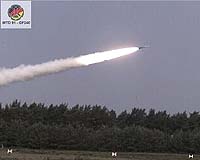
Munich, Germany (SPX) Sep 13, 2007 Live fire test of Rheinmetall Defence's Corect guidance module has confirmed its effectiveness in impressive fashion. The new satellite-supported flight path guidance modules successfully guided two Corect-MLRS test rockets to a target 20 km away with compelling precision, compensating for a lateral error of approximately 300 m. This proves the technical and operational effectiveness of the Corect guidance module in conjunction with the Multiple Launch Rocket System, or MLRS. The live fire test successfully concludes the second stage of the demonstrator programme, carried out by Rheinmetall Defence on behalf of Germany's Federal Office for Defence Technology and Procurement (BWB). The company will now submit a budget proposal for final development, pre-production preparations and serial manufacture. With Corect, Rheinmetall engineers at the company's Stockach and Unterluess plants have developed an advanced satellite-supported guidance system that significantly enhances the accuracy of ballistic artillery systems. The new system reduces deviation from the intended target to less than 50 m, a clear improvement over currently fielded artillery systems, which sometimes miss their targets by several hundred metres. This increase in accuracy enables reduced warhead weight without sacrificing effectiveness. Compared to the original MLRS rocket, the Corect-MLRS has a considerably greater maximum effective range - without having to modify the rocket engine. The Corect guidance module makes this possible. Throughout the flight, an integrated GPS receiver determines the current position of the projectile. A magnetic field sensor mounted on the rocket measures the earth's magnetic field, while an onboard processor calculates the way the rocket is banking. Based on this data, the onboard processor calculates the rocket's deviation from its intended flight path. It then initiates precisely timed impulses for correcting the rocket's lateral and elevation direction by activating the rocket's radially operating micro jets. During the live fire trial, every component of the Corect guidance module functioned perfectly. The GPS kept accurate track of the rocket's position, while the onboard processor calculated all deviation from the intended trajectory; the correction impulses proved highly effective, resulting in complete mission success. All data collected on board the rocket and transmitted back by telemetry, as well as flight data externally gathered by radar, are now available for precise evaluation. "Corect is a pioneering system for satellite-supported trajectory correction that's unequalled worldwide", declares Dr.-Ing. Wolfgang Kreuzer, head of development in Stockach and project manager for the demonstrator programme. "It boosts the precision and range of rocket artillery, and saves costs by reducing the amount of ammunition needed to accomplish the mission. And now we've proved that it can be used for modernizing legacy rocket systems, too, large numbers of which were stockpiled years ago", adds Dr. Kreuzer, noting that Corect can also be integrated into new weapon systems. Community Email This Article Comment On This Article Related Links The latest in Military Technology for the 21st century at SpaceWar.com
 Russian army touts new bomb on television
 Moscow (AFP) Sept 11, 2007
Russia's army on Tuesday unveiled a new seven-tonne explosive device on national television, touting the anti-terrorism bomb as four times more powerful than the strongest US explosives. |
|
|

| The content herein, unless otherwise known to be public domain, are Copyright 1995-2007 - SpaceDaily.AFP and UPI Wire Stories are copyright Agence France-Presse and United Press International. ESA Portal Reports are copyright European Space Agency. All NASA sourced material is public domain. Additional copyrights may apply in whole or part to other bona fide parties. Advertising does not imply endorsement,agreement or approval of any opinions, statements or information provided by SpaceDaily on any Web page published or hosted by SpaceDaily. Privacy Statement |