
 |
 |
 |
 |
 |
 |
 |
 |
 |

 |
Copenhagen Suborbitals Tests Hybrid Rocket
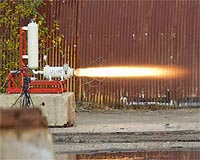
Copenhagen, Denmark (SPX) Oct 28, 2008 Danish based Copenhagen Suborbitals is developing a one person spacecraft and its booster rocket. We aim to send a person into space on a suborbital trajectory above 100 km. Our first milestone is to get safe and reliable rocket engines working. Sunday the 19th of October 2008, we tested our first hybrid rocket engine in Copenhagen. The test was a complete success and during the 10 seconds burn we recorded high speed video data and pressure recordings, which is currently being processed - as we refurbish the test motor for a new test. We have chosen to develop our rocket system in steps, where we slowly increase the size and complexity. The current rocket, just tested, was not aimed to fly but kept firmly on a concrete foundation in order to collect as many data as possible. Based on these data we are now able to perform the necessary changes to increase the rocket motor performance, since the test showed that we had a slight hot spot close to the oxidizer injection valve. When we have carried out more tests and the engine performs just right, we will build a flight configured version and launch. We expect the rocket to reach 30 km with a 10 Kg payload. After this we will construct the final lifting rocket for testing. Furthermore, we have now initiated the development of the space ship, which will carry one person. Firstly, we will construct a boiler plate version to assist the development of ingress/egress system, seating and parachute system as well as perform drop tests. Community Email This Article Comment On This Article Share This Article With Planet Earth
Related Links Copenhagen Suborbitals Rocket Science News at Space-Travel.Com
 More design flaws found in Ares I rocket
 Cape Canaveral, Fla. (UPI) Oct 26, 2008
 More problems have been found with the design of the next-generation manned U.S. spacecraft launch rocket, leading some to wonder if it will ever be built. |
|
|

| The content herein, unless otherwise known to be public domain, are Copyright 1995-2007 - SpaceDaily.AFP and UPI Wire Stories are copyright Agence France-Presse and United Press International. ESA Portal Reports are copyright European Space Agency. All NASA sourced material is public domain. Additional copyrights may apply in whole or part to other bona fide parties. Advertising does not imply endorsement,agreement or approval of any opinions, statements or information provided by SpaceDaily on any Web page published or hosted by SpaceDaily. Privacy Statement |
 del.icio.us
 Digg
Digg Reddit
 YahooMyWeb
 Google
 Facebook