|
 |
 |
 |
 |
 |
 |
 |
 |

 |
Cook Says US Missile Shield "Not A Threat" To Russia
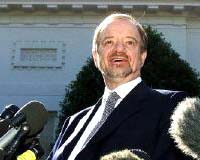
Washington (AFP) Feb. 7, 2001 British Foreign Secretary Robin Cook said Wednesday that "it should be possible" to allay Russian concerns about US President George W. Bush's plan to move ahead with a controversial national missile defense (NMD). "The proposed national missile defense is not in any way a threat to Russia," and is meant to respond to "rogue states," he told reporters after a meeting with Bush's national security advisor, Condoleezza Rice. "It should be possible to persuade Russia that this is not in any way destabilizing to Russia, and it should go ahead on the basis of an accommodation with Russia" said Cook. Cook also emphasized that the United States and Britain saw eye-to-eye on a host of "shared concerns," such as the Balkans, Libya, the Middle East, Iraq and downplayed differences on the enhanced EU military component Washington worries could threaten NATO. "On all of these issues we have found a meeting of minds and set up agenda for future work between us," he said, echoing comments he and US Secretary of State Colin Powell made after they met Tuesday. Cook said Washington should welcome the European Union's planned security and defense initiative (ESDI), which would include a rapid reaction force, because it will enhance Europe's ability to take a more substantial role in military deployments like peacekeeping. ESDI "will strengthen the capacity of Europe to contribute to crisis management, and therefore is welcome to a Washington that is interested in fairer burden-sharing," he said, emphasizing that "Britain will insist" that any such force will be "firmly anchored in NATO." On Iraq, Cook said Washington and London would work to "make sure that Saddam Hussein does not emerge as a military menace, recapturing his ability to develop weapons of mass destruction." And both sides must strive to "get across in international debate that it is Saddam Hussein who is the oppressor of the Iraqi people. It is we who actually want to help the Iraqi people deal with the humanitarian problems."
North Korea Remains Threat Tenet, director of the Central Intelligence Agency, admitted that North Korean leader Kim Jong-Il had embarked on a "bold diplomatic outreach" to the international community and South Korea in a "significant change in strategy." But he told the Senate Intelligence Committee that Pyongyang's huge army, missile program and sales of military technology meant the once isolated Stalinist state should still be considered a serious threat. "I can report to you that we have not yet seen a significant diminution of the threat from the North to American and South Korea interests," Tenet said. The Pyongyang government was following a gradual opening process only to ensure its survival and to fix its staggering economy, Tenet said. Despite an apparent decision to engage with the outside world, a strategy that saw Kim Jong-Il twice visit China in recent months and hold a summit with South Korea, the regime was taking a road fraught with uncertainty, he said. "The risk for Kim is that if he overestimates his control of the security services and loses elite support, or if societal stresses reach a critical point, his regime and personal grip on power could be weakened. "As with other authoritarian regimes, sudden, radical change remains a real possibility in North Korea." Tenet was speaking at the US Congress as South Korean Foreign Minister Lee Joung-Binn met US Secretary of State Colin Powell at the State Department, in the first face-to-face talks between South Korea and the new administration of President George W. Bush. While welcoming a thawing of relations between North and South Korea, the United States remains concerned about the potential threat from Pyongyang's missile program. Washington also accuses North Korea of sending military technology to its adversaries and of supporting terrorism. Former president Bill Clinton mulled making a historic trip to North Korea in the final days of his presidency, but decided a deal on dismantling Pyongyang's missile program remained out of reach. North Korea has pursued a campaign for diplomatic recognition over the past year, which has seen it establish relations with a string of Asian and Western nations -- the latest of which, Canada and Spain -- opened ties with Pyongyang this week. All rights reserved. � 2001 Agence France-Presse. All information displayed on this section (dispatches, photographs, logos) are protected by intellectual property rights owned by Agence France-Presse. As a consequence, you may not copy, reproduce, modify, transmit, publish, display or in any way commercially exploit any of the content of this section without the prior written consent of Agence France-Presse. CommunityEmail This Article Comment On This Article Related Links SpaceDaily Search SpaceDaily Subscribe To SpaceDaily Express Military Space News at SpaceWar.com
 Canada To Seek International Pact Banning Weapons In Space
 Ottawa (AFP) Jan 11, 2006
Canadian Prime Minister Paul Martin will seek an international pact to ban weapons in space if his Liberals are returned to power in a January 23 election, according to the party platform. |
|
|

|
|
|
|
|
|
|
|
|
|
|
|
| The content herein, unless otherwise known to be public domain, are Copyright 1995-2006 - SpaceDaily.AFP and UPI Wire Stories are copyright Agence France-Presse and United Press International. ESA PortalReports are copyright European Space Agency. All NASA sourced material is public domain. Additionalcopyrights may apply in whole or part to other bona fide parties. Advertising does not imply endorsement,agreement or approval of any opinions, statements or information provided by SpaceDaily on any Web page published or hosted by SpaceDaily. Privacy Statement |