|
 |
 |
 |
 |
 |
 |
 |
 |

 |
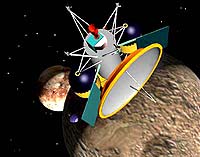
Contract Will Help Spacecraft Stay On The Ball In Deep Space
Boulder - October 2, 2000 Ball Aerospace & Technologies Corp. (BATC) has been awarded a $10.4 million contract from the California Institute of Technology, Jet Propulsion Laboratory for the design and development of a Stellar Reference Unit (SRU) for the Outer Planets/Solar Probe Project. The Stellar Reference Unit enables the Attitude Control Subsystem aboard the spacecraft to provide sufficient image data for simultaneous three-axis determination of spacecraft attitude by the Space Flight Computer. The SRU consists of a baffle, optics, a Focal Plane Array (FPA), FPA control electronics (analog), digital electronics, a power converter, connectors and cables and an interface to communicate with the Spacecraft Flight Computer. This contract is a follow-on to a study contract that Ball Aerospace began in May 1999 and features Ball Aerospace's unique design approach for a radiation hardened Stellar Reference Unit. Deliverables include one engineering unit, one protoflight unit and four flight units. The SRUs were slated to fly on the Pluto Kuiper Express Mission in 2004 and the Europa Mission in 2007, but the Pluto Kuiper Express has recently been deferred so two of the flight units are seeking utilization opportunities elsewhere. Community Email This Article Comment On This Article Related Links Outer Planets/Solar Probe Project Ball Aerospace SpaceDaily Search SpaceDaily Subscribe To SpaceDaily Express Space Technology News - Applications and Research
 Industry Team Achieve New Communications Technology With AESA Radars
 Baltimore MD (SPX) Jan 12, 2006
A team comprised of three leading US aerospace and defense contractors has demonstrated an innovative technological use of active electronically scanned array (AESA) radars for high-bandwidth communications. |
|
|

|
|
|
|
|
|
|
|
|
|
|
|
| The content herein, unless otherwise known to be public domain, are Copyright 1995-2006 - SpaceDaily.AFP and UPI Wire Stories are copyright Agence France-Presse and United Press International. ESA PortalReports are copyright European Space Agency. All NASA sourced material is public domain. Additionalcopyrights may apply in whole or part to other bona fide parties. Advertising does not imply endorsement,agreement or approval of any opinions, statements or information provided by SpaceDaily on any Web page published or hosted by SpaceDaily. Privacy Statement |