|
 |
 |
 |
 |
 |
 |
 |
 |

 |
Congress To Boosts Israeli Missile Defense System Arrow
UPI Senior News Analyst Washington (UPI) Oct 03, 2006 The U.S. Congress has voted $150 million to boost joint BMD development with Israel. Prime beneficiaries of the provisions included in the U.S. defense appropriations bill last week will be the Israel Aircraft Industries' Arrow interceptor and $20 million to revive development of a promising system to defend against very short-range rocket artillery barrages, the Jerusalem Post reported Saturday. Early work on a short-range ballistic missile defense system that could provide protection from Katyusha rockets was urged by Israel but shelved by Pentagon officials, according to previous reports monitored in BMD Watch. However, the issue became a hot button one again when Hezbollah, the Shiite Party of God in southern Lebanon, fired thousands of Katyusha multiple rocket mortar projectiles into northern Israel during the recent conflict there. The rockets caused relatively few civilian casualties owing to their poor accuracy and the diffusion of the bombardment. But it brought home to both Israeli and U.S. defense establishment analysts the need to develop some kind of defense against a technology that has existed for more than 60 years. The funding was double the amount the Bush administration had initially requested for joint projects, the Jerusalem Post noted. As such, it was a significant victory for the powerful pro-Israel lobby in Congress. Reflecting the perceived urgency of the need to fund the short-range program and accelerate the Arrow one, the funding was in addition to the massive U.S. foreign aid package that Israel receives annually. The newspaper report said that the Arrow anti-missile system would receive an extra $135 million to facilitate what it described as "co-production of the system components in the U.S. and for developing improvements." The Arrow is Israel's primary strategic protection against the threat of intermediate-range, Iranian Shihab missiles that could carry nuclear warheads. -0- Japan this weekend received its first shipment of equipment to prepare for a U.S. Patriot PAC-3 battery deployment on Okinawa, the Kyodo news agency reported Sunday. The deployment agreement was pushed through by former Japanese Prime Minister Junichiro Koizumi and is enthusiastically supported by his handpicked successor, Shinzo Abe. The first Patriot battery on Okinawa is "scheduled to go partially online later this year at the U.S. Kadena Air Base and the U.S. Air Force's Kadena Ammunition Storage Area, the U.S. military said," according to the Kyodo report. The equipment shipment was sent in advance of the first shipment of Patriot Advanced Capability-3 interceptors. They are expected to "be delivered within two weeks to a U.S. military facility in Uruma, Okinawa Prefecture," Koydo said. The system is expected to become partially operational by the end of this year and to be fully operational by the end of March, the report said. The Patriots will be the first ballistic missile defense system ever to be deployed in Japan. The deployment comes following North Korea's successful test launch of six nuclear-capable missiles capable of reaching Japan on July 4. As the main U.S. military base in the region, Okinawa is expected to be a primary target in any North Korean ballistic missile attack. But Koizumi and the Bush administration agreed to the PAC-3 deployment in May, before those tests. -0- South Korea has inaugurated a new missile defense command, the China Post reported last week. The newspaper cited unidentified South Korean military officials as saying that the new command center would improve South Korea's defenses against the threat posed by North Korea's missiles and artillery deployment. North Korea is believed to have at least 11,000 artillery and rocket tubes capable of bombarding South Korea's capital Seoul and South Korean defense forces south of the Demilitarized Zone. The South Korean army announced that the new command would be located in the center of the country and that it began operating on Thursday, Sept. 28. The new command was "aimed at effectively countering current and future threats," the army said in a statement, according to the report. The army statement also said that the new command would direct South Korea's artillery and ground-to-ground missiles. United Press International reported Friday that Raytheon Co. had agreed to sell South Korea a $1.5 billion Patriot missile system. The South Korean news agency Yonhap said the company had plans to deliver the new surface-to-air missile system as early as 2008 and that it would also offer provide training to operate the interceptors. UPI said the purchase was part of South Korea's $150 billion emergency defense allocation that was passed after neighboring North Korea carried out its six successful missile tests on July 4. A more ambitious test of an intercontinental ballistic missile, the Taepodong-2, on the same day was a failure. Yonhap said the Raytheon agreement, which would reportedly be combined with the purchase of missile launchers from Germany, still required U.S. congressional approval.
Source: United Press International Community Email This Article Comment On This Article Related Links Learn about missile defense at SpaceWar.com Learn about missile defense at SpaceWar.com Learn about nuclear weapons doctrine and defense at SpaceWar.com All about missiles at SpaceWar.com Learn about the Superpowers of the 21st Century at SpaceWar.com
 Northrop Grumman Completes Payload Acoustic Testing For SBIRS GEO-1 Payload
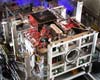 Azusa CA (SPX) Oct 04, 2006
Northrop Grumman Corp. has announced that it has successfully completed acoustic testing of the payload for the first Space-Based Infrared System (SBIRS) geosynchronous orbit (GEO) satellite. The company will provide the payload to Lockheed Martin, the prime contractor and systems integrator for SBIRS. |
|
|

| The content herein, unless otherwise known to be public domain, are Copyright 1995-2006 - SpaceDaily.AFP and UPI Wire Stories are copyright Agence France-Presse and United Press International. ESA PortalReports are copyright European Space Agency. All NASA sourced material is public domain. Additionalcopyrights may apply in whole or part to other bona fide parties. Advertising does not imply endorsement,agreement or approval of any opinions, statements or information provided by SpaceDaily on any Web page published or hosted by SpaceDaily. Privacy Statement |