|
 |
 |
 |
 |
 |
 |
 |
 |

 |
Conference To Discuss Asteroid Danger
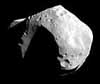
Ithaca - July 22, 1999 - The possibility of the Earth being struck by comets or asteroids is being given more and more attention by researchers, according to Paul Chodas of NASA's Jet Propulsion Laboratory (JPL). Chodas will discuss this potential threat to the planet when he moderates one of the daily press conferences that will provide important new insights into the latest space research at the seventh International Asteroids, Comets and Meteors Conference at Cornell University July 26-July 30. A schedule of the press conferences is available on the ACM media website. The site provides the latest press releases on research to be reported at the conference, as well as a list of researchers from around the world who will be attending the meeting. Chodas's press conference will cover asteroids and meteors collectively known as near-Earth objects (NEO's). Other participants will include David Rabinowitz of JPL, Richard Binzel of the Massachusetts Institute of Technology, Alan Harris of the Jet Propulsion Laboratory (JPL) and Andrea Milani of the University of Pisa, Italy. In recent movies, asteroids and comets are shown threatening to collide with the Earth, only to be destroyed at the last minute by astronaut heroics. But Chodas believes that the hazards of collisions with comets or asteroids are more than a topic for fiction. Chodas and Milani will discuss their independent efforts to predict close-Earth approaches and impact probabilities further into the future than has been previously possible. It has been estimated that only 15 to 20 percent of NEO's larger than one kilometer have been detected to date. Several telescopic discovery programs are actively searching for these large NEO's, and the discovery rate is increasing. However, Chodas believes, it may be at least 10 years before 90 percent of the total population is revealed. A new analysis by Rabinowitz shows that there may be only half as many large hazardous objects as previously estimated. Harris will present new evidence to refute a controversial theory that the Earth is continually bombarded by a population of house-sized comets. What is the nature of these seemingly "loose cannons" that might be posing a threat? A new view has evolved, suggesting that many large asteroids are "rubble-piles," according to William Bottke, a research associate in Cornell's Department of Astronomy, who will moderate the press session (Friday, July 30, 10 a.m., Princeton-Yale Room, Statler Hotel) on asteroid moons and spins. Other participants will include Petr Pravec of Ondrejov Astronomy Institute, Czech Republic, and JPL's Harris. Until recently, most planetary scientists considered asteroids to be little more than beat-up rocks in space, with solid interiors and lunar-like surfaces. It is difficult to prove or disprove this theory since remote sensing techniques can only probe the top layers of an asteroid's surface, says Bottke. But data taken from spacecraft fly-bys, ground-based observations and computer modeling indicate that large asteroids are no more than piles of rubble held together not by physical strength but by the gravitational attraction of the pieces of rubble. Although Pravec's research, based on an extensive study of near-Earth asteroid (NEA) rotation rates, is consistent with the "rubble-pile" scenario, his new results suggest that some small asteroids are solid. At the conference he will discuss two asteroids, 1996 KY26 and 1995 HM, both smaller than 100 meters, that are spinning so fast that they have to be solid objects -- weakly bound rubble piles fly apart if spun too fast. These two bodies are small enough that they provide the "missing link" to the rubble-pile theory that astronomers have been looking for -- filling the gap between between kilometer-size asteroids that cannot spin overly fast and fast-spinning meter-sized meteorites that are known to be solid. Computer modeling suggests the transition size for solid objects to turn into rubble piles is roughly a few hundred meters in diameter. More support for the rubble-pile theory also comes from Pravec: He will report that many NEO's have small moons. These moons are most likely to be a by-product of close encounters between rubble-pile asteroids and planets. When a rubble-pile asteroid passes too close to a planet like Earth, tidal forces can pull it apart, leaving some of the fragments to orbit one another.
Current NEO Articles at SpaceDaily
Related News Baskets at SpaceDaily
Email This Article Comment On This Article Related Links Space
 Satellite Launch To Boost DTH In India
 Calcutta, India (SPX) Dec 28, 2005
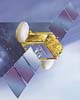
The successful launch Thursday of India's heaviest satellite from spaceport of Kourou in French Guyana may have boosted the country's space research efforts to yet another level, but it has also lifted the spirits of at least three Direct-To-Home televisions broadcasters, one of which has been waiting for years to launch its services in India. |
|
|

|
|
|
|
|
|
|
|
|
|
|
|
| The content herein, unless otherwise known to be public domain, are Copyright 1995-2006 - SpaceDaily.AFP and UPI Wire Stories are copyright Agence France-Presse and United Press International. ESA PortalReports are copyright European Space Agency. All NASA sourced material is public domain. Additionalcopyrights may apply in whole or part to other bona fide parties. Advertising does not imply endorsement,agreement or approval of any opinions, statements or information provided by SpaceDaily on any Web page published or hosted by SpaceDaily. Privacy Statement |