|
 |
 |
 |
 |
 |
 |
 |
 |

 |
Concrete In UAH's New Canoe May Be Next Space-Age Material
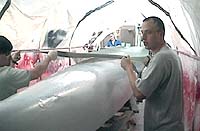
Huntsville - June 11, 2001 With 14 years of experience and four national championships under their belts, the idea of building a racing canoe out of concrete no longer seems odd to engineering faculty and students at The University of Alabama in Huntsville (UAH). But spaceships made of concrete? It could happen. A unique concrete mixture developed by UAH students for their concrete canoe has team members and their faculty advisors convinced that concrete could be the next wonder material of the space age. "There's a really good chance these materials will replace the aerospace composites that are out there now," says UAH's Dr. John Gilbert. "I think we can make structures out of concrete that are lighter and more flexible than structures made of graphite epoxy composites." The UAH concrete could be used to support telescopes in space, for rocket fuselages, to build a lunar colony -- or for low-cost emergency shelters on Earth. "A space station wall or space telescope mount made of this might be thicker than graphite composites, but it wouldn't necessarily be heavier," said Gilbert, a team coach and professor of mechanical engineering. "The concrete is the lightest part of the mixture. And since concrete is pretty inert, it would be less vulnerable to things like radiation or atomic oxygen erosion." The secret is in the recipe. UAH's flexible concrete is the end product of more than 200 different combinations that were mixed and tested. It is made of Portland cement, glass microbeads (microscopic hollow spheres), latex, acrylic fortifier and water. Mix in the right proportions, then dry for 12 hours. The end product is concrete so light that a solid block will float in water, and so flexible it can bend without breaking. The bending part is important, since UAH's new canoe, "Survivor," has no internal struts or supports to stiffen the boat. Instead, it was intentionally designed to bend and flex -- to "swim" -- as it goes through the water. Designing a watercraft to flex and bend is a revolutionary proposal in civil and mechanical engineering -- fields where structures and vehicles are normally designed and reinforced to reduce or eliminate bending and twisting. It's even more revolutionary that the UAH team intentionally lowered the boat's natural harmonic, "tuning" the canoe so it reaches resonance when it is raced at the national concrete canoe championships June 14-16 in San Diego, California. In engineering, resonance is almost always thought to be a bad thing. Every object has a natural frequency or wavelength, based on its size, shape, density and other physical properties. Matching an object's natural frequency with outside forces, such as sound waves, releases tremendous energy and can shake the object to pieces. That's why certain high frequency musical notes can break glass. Perhaps the best known example of what happens when a large structure reaches resonance was the first Tacoma Narrows suspension bridge. Powerful wind blowing through the bridge cables set up an extremely low frequency hum that matched the bridge's natural frequency. The bridge deck started to rise and fall in great waves. News film of the bridge shaking itself to pieces on Nov. 7, 1940, is still shown on television documentaries around the world. In the decades that followed, special techniques were developed to help architects and engineers avoid harmonic resonance in everything from bridges and skyscrapers to cars and airplanes. So why would anyone design a canoe specifically to do what the Tacoma Narrows bridge did? To capture that energy. A boat moving through water sets up waves. Some waves are pushed away and become wake. Others flow under the boat. If the boat is rigid, those waves set up turbulence and cause drag. The boat has to fight against those forces to move forward. A canoe that reaches resonance in the water, however, might move with the water rather than against it, Gilbert said. Survivor is designed to flex during each paddle stroke, storing energy, then to release that energy and surge forward between stokes. "The boat surges forward and 'swims' between strokes," said Gilbert. "It is unlike any other boat in the field. It is an entity that no one has ever reckoned with before." At the southeastern regional concrete canoe competition earlier this year, the team found that the boat's flexing and bending also gives its passengers a ride that takes some getting used to. Compared to earlier rigid canoes, it was like the difference between riding a bicycle and riding a camel. "We really had to train it and ourselves," Gilbert said. "We're trying to deal with something that's as close to a living thing as we've ever had. You have to get used to that actually in the saddle, so to speak." While the concrete canoe team's "tuned" technology is theoretically sound, extensive testing that might damage the canoe will have to wait until after the national competition. Community Email This Article Comment On This Article Related Links Team UAH - CC Survivor SpaceDaily Search SpaceDaily Subscribe To SpaceDaily Express Space
 Satellite Launch To Boost DTH In India
 Calcutta, India (SPX) Dec 28, 2005
The successful launch Thursday of India's heaviest satellite from spaceport of Kourou in French Guyana may have boosted the country's space research efforts to yet another level, but it has also lifted the spirits of at least three Direct-To-Home televisions broadcasters, one of which has been waiting for years to launch its services in India. |
|
|

|
|
|
|
|
|
|
|
|
|
|
|
| The content herein, unless otherwise known to be public domain, are Copyright 1995-2006 - SpaceDaily.AFP and UPI Wire Stories are copyright Agence France-Presse and United Press International. ESA PortalReports are copyright European Space Agency. All NASA sourced material is public domain. Additionalcopyrights may apply in whole or part to other bona fide parties. Advertising does not imply endorsement,agreement or approval of any opinions, statements or information provided by SpaceDaily on any Web page published or hosted by SpaceDaily. Privacy Statement |