|
 |
 |
 |
 |
 |
 |
 |
 |

 |
Concorde and What AeroAstro Does
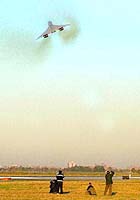
Washington - Oct 29, 2003 I get a lot of requests to define what our little space company, AeroAstro, is, and I spend a lot of time thinking about the question of our role as a spec within the gigantic aerospace industry. One thing we are is space pragmatists. We are not trying to boldly go just for the sake of going, nor to realize a human destiny to explore the stars. We're here to provide a pathway to working in space that's spontaneous - quick, low cost, and unfiltered by layers of experts and contractors. You don't need a CS degree to surf the Web, you shouldn't need an engineering or physics degree to try your idea in space. You don't need the buying power of a small country to fly a Cessna, and you shouldn't to drive a spacecraft. Etc. This seems simple, but reading the AAS annual meeting announcement, I realized how strange we really are. Searching for water on the moon, human exploration of Mars and the outer planets, military applications of human spaceflight. These are topics that excite space people - they don't excite me. I' m not against dreaming of humans living on Mars, but what excites me is the progression of technology from a state of expensive, complex fragility, to rugged, cheap utility. Radio, telephone, computers, automobiles, aircraft, videotape, digital photography - every successful technology manages this transition. But it isn't the technology which "manages" the transition - it's engineers, bizdev and business professionals, and they don't perform those miracles out of altruistic love of technology. If you needed a Caltech PhD to use a phone, it wouldn't be an industry, wouldn't create jobs and factories and serve billions of people every day. Instead, the phone would be a laboratory curiosity that the average person read about or saw on TV occasionally, and maybe hoped would inspire her or his kid to study harder. Pushing the frontiers of human civilization, fighting wars and esoteric science will always be a part of space. I hope they will be an increasingly unimportant part of space, not by shrinking, but by growth of individual use of space, for whatever people want to do with it, however whimsical, and for improving commercial services from space (SENS comes to mind). Similarly, we don't ignore those government customers - they are an anchor of the space world of today, and they advance the technology we all need. But space doesn't lack for technology so much as it lacks for the inclination, the necessity, of playing to the larger markets of people who don't have technical expertise, institutional budgets and decades long time scales. The press coverage of the Concorde's last flight reminded me of all this. Passenger aircraft are a large commercial business, their services are affordable by most people, at least in the first world (if not most, at least some of the second and almost none of the third) and they make a big difference in modern life every day. We take for granted that if necessary, we can be in Albuquerque, or Rome, tomorrow. Without aircraft, those trips take many days or weeks. Getting a gadget delivered overnight fedex is an American birthright. But the beautiful, technologically sophisticated Concorde... ...didn't make the transition. The difference between the ubiquity of the inelegant but utilitarian 737, and the Concorde, is only a factor of 4x in cost. One other lesson of Concorde. I was in elementary school when the concept was introduced in '62. I was entering High School during its first flight in '69, and graduating college when it entered commercial service in '76. What I remember is how cool I thought it was, and how opposed to it was the general public. It was perceived as a then-new European assault on US aerospace supremacy (pre-Airbus). Who could tell if all the ranting about noise was really about noise, or just noise about not in my backyard and not invented here. Airport after airport closed to Concorde, and a series of obstacles dogged its acceptance. We have finally succeeded in killing this upstart, obnoxious Concorde, and the public now mourns our collective loss. This is the thanks that engineers and business people can count on if we dare to innovate. The lesson isn't that it's a waste of our time to find a new way to do space - but that we shouldn't expect people to thank us along the way, and that we must achieve our promise, of making space cheap, simple, reliable and spontaneous, despite the obstacles. That's our real challenge. Community Email This Article Comment On This Article Related Links AeroAstro SpaceDaily Search SpaceDaily Subscribe To SpaceDaily Express Space Tourism, Space Transport and Space Exploration News
 NASA Refines Design For Crew Exploration Vehicle
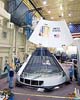 Washington DC (SPX) Jan 12, 2006
NASA's Constellation Program is making progress toward selecting a prime contractor to design, develop and build the Crew Exploration Vehicle (CEV), America's first new human spacecraft in 30 years. |
|
|

| The content herein, unless otherwise known to be public domain, are Copyright 1995-2006 - SpaceDaily.AFP and UPI Wire Stories are copyright Agence France-Presse and United Press International. ESA PortalReports are copyright European Space Agency. All NASA sourced material is public domain. Additionalcopyrights may apply in whole or part to other bona fide parties. Advertising does not imply endorsement,agreement or approval of any opinions, statements or information provided by SpaceDaily on any Web page published or hosted by SpaceDaily. Privacy Statement |