|
 |
 |
 |
 |
 |
 |
 |
 |

 |
Computer predicts Voyager 2 milestone
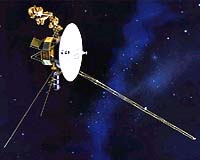
Riverside, Calif. (UPI) Nov 29, 2007 A U.S. physicist has predicted an expected milestone in the journey of the Voyager 2 spacecraft will occur within the next several weeks. University of California-Riverside physicist Haruichi Washimi, using a computer model simulation, has predicted when the interplanetary spacecraft will cross the so-called "termination shock" -- a spherical shell around the solar system that marks the point at which the solar wind slows to subsonic speed. According to Washimi's simulations, the spacecraft will cross the termination shock late this year or early in 2008. "Washimi's model has predicted the location of a boundary that is approximately 90 times farther from the sun than is the Earth, to within a few percent," said Gary Zank, director of the Institute of Geophysics and Planetary Physics and one of the co-authors of the research paper. "This is truly remarkable given the enormous complexity of the physics involved, the temporal and spatial scales involved, and the variability of the solar wind conditions." The complex research is detailed in the Dec. 1 issue of The Astrophysical Journal. Community Email This Article Comment On This Article Related Links Space Tourism, Space Transport and Space Exploration News
 Computer Simulation Predicts Voyager 2 Will Reach Major Milestone In Late 2007�Early 2008
 Riverside CA (SPX) Nov 28, 2007
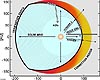
Using a computer model simulation, Haruichi Washimi, a physicist at UC Riverside, has predicted when the interplanetary spacecraft Voyager 2 will cross the �termination shock,� the spherical shell around the solar system that marks where the solar wind slows down to subsonic speed. |
|
|

| The content herein, unless otherwise known to be public domain, are Copyright 1995-2007 - SpaceDaily.AFP and UPI Wire Stories are copyright Agence France-Presse and United Press International. ESA Portal Reports are copyright European Space Agency. All NASA sourced material is public domain. Additional copyrights may apply in whole or part to other bona fide parties. Advertising does not imply endorsement,agreement or approval of any opinions, statements or information provided by SpaceDaily on any Web page published or hosted by SpaceDaily. Privacy Statement |