|
 |
 |
 |
 |
 |
 |
 |
 |

 |
Computer Technology Developed By Hebrew University Can Save Lives
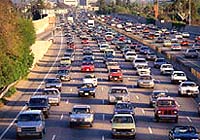
Israel (SPX) Jun 29, 2004 No one likes a back-seat driver. But imagine having a silent "co-pilot" in your car that isn't a pest but can save your life, as well as those of your passengers and those in the path of your vehicle. That's what EyeQ, a computer chip developed by MobilEye - a company founded by Prof. Amnon Shashua, chairman of the Hebrew University of Jerusalem's School of Engineering and Computer Science - is capable of doing. The chip operates in conjunction with a video camera that is mounted on the dashboard of a vehicle and that sends information on what it sees to an on-board computer containing the EyeQ chip. The chip has been so "instructed" that it can distinguish between ordinary, non-threatening observations seen by the camera (stationary objects at the side of the road, for example) and imminent hazards, such as a pedestrian suddenly crossing in front of the car. In dangerous situations, the information can be transmitted from the computer to instruments that sound warnings or even take automatic corrective steps involving the operation of the vehicle. For his work in developing this system for improved driving safety, Prof. Shashua was the first-prize winner this year of a Kaye Innovation Award at the Hebrew University. The award was presented in June during the 67th meeting of the university's Board of Governors. MobileEye was established by Prof. Shashua and Ziv Aviram as the outgrowth of Prof. Shashua's work in developing EyeQ. The company today employs some 80 people at its facility in Jerusalem's Har Hotzvim high-tech industrial park. EyeQ arose from an earlier system developed by Prof. Shashua for controlling manufacturing processes and providing quality control that combined optics and computer analysis. However, that system was relatively simple to implement, due to its operation in a controlled environment, compared to the challenge of "teaching" a computer chip to analyze the thousands of variables that the human driver sees and takes into consideration while driving. These variables include different lighting and weather conditions, lane markings, immobile objects, pedestrians and vehicles moving at various speeds and in different directions � the list is almost endless. The work of collecting and interpreting this visual data was done in both the laboratory and under actual driving conditions Proposed applications of EyeQ include a warning signal for drivers straying out of their lanes, automatic cruise control to regulate the speed of the car depending on traffic movement, and automatic tightening of seat belts and extra pressure on the brake pedal in the event of an imminent crash. While there are a few systems already on the market for dealing with some of these safety functions, they are based on expensive radar technology, which is more limited in its scope than the camera-computer analysis method of MobilEye. The company has so far raised $45 million in investment capital over four rounds � the last based on a valuation potential of $200 million. "We're offering something that is very, very useful, and we're working with major car and parts manufacturers in the U.S., Europe and Japan to integrate the technology into a wide range of production programs," said Prof. Shashua. He expressed the expectation that at least some of the safety apparatus that will come out of EyeQ applications will soon become standard safety gear on cars, as did such earlier developments as seat belts and air bags. Community Email This Article Comment On This Article Related Links Hebrew University of Jerusalem SpaceDaily Search SpaceDaily Subscribe To SpaceDaily Express Space Technology News - Applications and Research
 Industry Team Achieve New Communications Technology With AESA Radars
 Baltimore MD (SPX) Jan 12, 2006
A team comprised of three leading US aerospace and defense contractors has demonstrated an innovative technological use of active electronically scanned array (AESA) radars for high-bandwidth communications. |
|
|

| The content herein, unless otherwise known to be public domain, are Copyright 1995-2006 - SpaceDaily.AFP and UPI Wire Stories are copyright Agence France-Presse and United Press International. ESA PortalReports are copyright European Space Agency. All NASA sourced material is public domain. Additionalcopyrights may apply in whole or part to other bona fide parties. Advertising does not imply endorsement,agreement or approval of any opinions, statements or information provided by SpaceDaily on any Web page published or hosted by SpaceDaily. Privacy Statement |