|
 |
 |
 |
 |
 |
 |
 |
 |

 |
Computer Simulation Shows Buckyballs Deform DNA
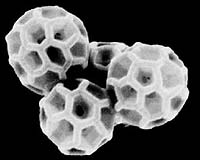
Nashville TN (SPX) Dec 07, 2005 Soccer-ball-shaped "buckyballs" are the most famous players on the nanoscale field, presenting tantalizing prospects of revolutionizing medicine and the computer industry. Since their discovery in 1985, engineers and scientists have been exploring the properties of these molecules for a wide range of applications and innovations. But could these microscopic spheres represent a potential environmental hazard? A new study published in December 2005 in Biophysical Journal raises a red flag regarding the safety of buckyballs when dissolved in water. It reports the results of a detailed computer simulation that finds buckyballs bind to the spirals in DNA molecules in an aqueous environment, causing the DNA to deform, potentially interfering with its biological functions and possibly causing long-term negative side effects in people and other living organisms. The research, conducted at Vanderbilt by chemical engineers Peter T. Cummings and Alberto Striolo (now a faculty member at the University of Oklahoma), along with Oak Ridge National Laboratory scientist Xiongce Zhao, employed molecular dynamics simulations to investigate the question of whether buckyballs would bind to DNA and, if so, might inflict any lasting damage. "Safe is a difficult word to define, since few substances that can be ingested into the human body are completely safe," points out Cummings, who is the John R. Hall Professor of Chemical Engineering and director of the Nanomaterials Theory Institute at Oak Ridge National Laboratory. "Even common table salt, if eaten in sufficient quantity, is lethal. What we are doing is looking at the mechanisms of interaction between buckyballs and DNA; we don't know yet what actually happens in the body," he says. Surprising findings Despite the caveat, Cummings suggests that his research reveals a potentially serious problem: "Buckyballs have a potentially adverse effect on the structure, stability and biological functions of DNA molecules." The findings came as something of a surprise, despite earlier studies that have shown buckyballs to be toxic to cells unless coated and to be able to find their way into the brains of fish. Before these cautionary discoveries, researchers thought that the combination of buckyballs' dislike of water and their affinity for each other would cause them to clump together and sink to the bottom of a pool, lake, stream or other aqueous environment. As a result, researchers thought they should not cause a significant environmental problem. Cummings' team found that, depending on the form the DNA takes, the 60-carbon-atom (C60) buckyball molecule can lodge in the end of a DNA molecule and break apart important hydrogen bonds within the double helix. They can also stick to the minor grooves on the outside of DNA, causing the DNA molecule to bend significantly to one side. Damage to the DNA molecule is even more pronounced when the molecule is split into two helices, as it does when cells are dividing or when the genes are being accessed to produce proteins needed by the cell. "The binding energy between DNA and buckyballs is quite strong," Cummings says. "We found that the energies were comparable to the binding energies of a drug to receptors in cells." It turns out that buckyballs have a stronger affinity for DNA than they do for themselves. "This research shows that if buckyballs can get into the nucleus, they can bind to DNA," Cummings says. "If the DNA is damaged, it can be inhibited from self-repairing." Computer simulations The computer simulations showed that buckyballs make first contact with the DNA molecule after one to two nanoseconds. Once the C60 molecules bind with the DNA, they remained stable for the duration of the simulation. Researchers tested the most common forms of DNA, the "A" and "B" forms. The "B" form is the most common form. In a stronger saline solution, or when alcohol is added, the DNA structure can change to the "A" form. A third, rarer form, "Z," occurs in high concentrations of alcohol or salt and was not tested. The researchers found that buckyballs docked on the minor groove of "A" DNA, bending the molecule and deforming the stacking angles of the base pairs in contact with it. The simulations also showed that buckyballs can penetrate the free end of "A" form DNA and permanently break the hydrogen bonds between the end base pair of nucleotides. As expected, the buckyballs bound most strongly to single helix DNA, causing the most deformation and damage. While buckyballs did bind to "B" form double-strand DNA, the binding did not affect the overall shape of the DNA molecule. More research needed What the researchers don't know is whether these worrisome binding events will take place in the body. "Earlier studies have shown both that buckyballs can migrate into bodily tissues and can penetrate cell membranes," Cummings says. "We don't know whether they can penetrate a cell nucleus and reach the DNA stored there. What this study shows is that if the buckyballs can get into the nucleus they could cause real problems. What are needed now are experimental and theoretical studies to demonstrate whether they can actually get there. Because the toxicity of nanomaterials like buckyballs is not well known at this point, they are regarded in the laboratory as potentially very hazardous, and treated accordingly." Community Email This Article Comment On This Article Related Links Vanderbilt University of Oklahoma Oak Ridge National Laboratory SpaceDaily Search SpaceDaily Subscribe To SpaceDaily Express Carbon Worlds - where graphite, diamond, amorphous, fullerenes meet
 Matchbox-Size Nano-Projector Engine For Mobile Apps
 Taunton MA (SPX) Jan 5, 2006
Kopin and ExPlay have announced that they are in development of an ultra-small nano projector based on an ultra-high-efficiency version of Kopin's microdisplay, which is being specifically designed for the nano projector, and ExPlay's unique optical technology. |
|
|

| The content herein, unless otherwise known to be public domain, are Copyright 1995-2006 - SpaceDaily.AFP and UPI Wire Stories are copyright Agence France-Presse and United Press International. ESA PortalReports are copyright European Space Agency. All NASA sourced material is public domain. Additionalcopyrights may apply in whole or part to other bona fide parties. Advertising does not imply endorsement,agreement or approval of any opinions, statements or information provided by SpaceDaily on any Web page published or hosted by SpaceDaily. Privacy Statement |