
 |
 |
 |
 |
 |
 |
 |
 |
 |

 |
Computational Analysis Improves I-500 Warhead Survivability
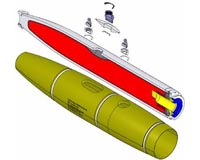
Air Force Research Laboratory Munitions Directorate Eglin AFB FL (AFPN) Jun 20, 2008 Air Force Research Laboratory engineers here conducted dynamic computational analysis geared toward improving the survivability of a proposed I-500 warhead design. Ongoing computational analysis suggests that resulting changes should significantly increase the warhead's structural survivability during its penetration into hardened targets. The new design is slated for sled test during this summer. The intent of this warhead is to provide hard-target penetration capability while duplicating the properties of mass, external dimensions and external interfaces that are hallmarks of the Mk-82 general-purpose bomb. By designing the I-500 weapon according to these constraints, engineers were able to forgo the flight certification process required for new warheads, decreasing program costs and the time needed for transitioning the technology to the warfighter. The advanced computational analysis methods employed for this effort enabled assessment of the warhead's performance throughout its penetration of a hardened target. The I-500 concept consists of a hardened penetrator encased in a lightweight composite shroud that captures the outer moldline of the Mk-82. It also includes an arming well cut into the side of the penetrator's steel casing in order to accommodate standard cable attachments for fuse arming and thereby match existing external interfaces of the Mk-82. AFRL's structural analysis of the I-500 predicted that significant localized deformation around the arming well hole would occur during oblique penetration into a hardened concrete target. Such deformation would indicate a very high risk of warhead case fracture, an event likely to precipitate catastrophic systems failure. Based on these results, AFRL engineers subsequently redesigned the I-500 for enhanced survivability. In order to mitigate the risk of structural failure during penetration, AFRL's design improvements included recommendations to locally increase case thickness near the arming well hole (providing extra stiffness), repackage the fuse-arming unit inside the arming well (reducing the hole's diameter by approximately 20 percent), and add a tip to the originally blunt nose (decreasing deceleration loads during penetration). Community Email This Article Comment On This Article Share This Article With Planet Earth
Related Links the missing link The latest in Military Technology for the 21st century at SpaceWar.com
 Wind Tunnel Tests Contribute To First Flight Of F-35
 Arnold AFB (AFPN) Jun 19, 2008
The June 11 completion of the first flight of the short takeoff/vertical landing version of the F-35 Lightning II Joint Strike Fighter resonated with Air Force engineers at the Arnold Engineering Development Center here. |
|
|

| The content herein, unless otherwise known to be public domain, are Copyright 1995-2007 - SpaceDaily.AFP and UPI Wire Stories are copyright Agence France-Presse and United Press International. ESA Portal Reports are copyright European Space Agency. All NASA sourced material is public domain. Additional copyrights may apply in whole or part to other bona fide parties. Advertising does not imply endorsement,agreement or approval of any opinions, statements or information provided by SpaceDaily on any Web page published or hosted by SpaceDaily. Privacy Statement |
 del.icio.us
 Digg
Digg Reddit
 YahooMyWeb
 Google
 Facebook