|
 |
 |
 |
 |
 |
 |
 |
 |

 |
Compression Experiments In World's Largest Pulse Power Machine Completed
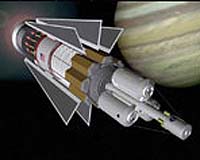
Seattle - Apr 08, 2003 Andrews Space & Technology (AS&T) successfully demonstrated the fundamental operating principles of a propulsion system that could dramatically affect interplanetary space travel, shortening round trips to Mars from two years to six months and making future trips to Jupiter and back a two-year affair. AS&T tested the Company's Mini-Mag Orion propulsion concept by completing two magnetic compression technology experiments in the world's largest pulse power machine under a NASA Phase II Small Business Innovative Research (SBIR) contract. In cooperation with Sandia National Laboratories and the University of Washington's Department of Aeronautics & Astronautics, AS&T successfully verified the process of compressing solid matter to high densities in an electromagnetic field. A space propulsion system using the same processes would have the same thrust as the Space Shuttle Main Engine, but be fifty (50) times more efficient. The Mini-Mag Orion system, short for Miniature Magnetic Orion, is a scaled down but more efficient version of the 1958 Orion interplanetary propulsion concept. The original Orion concept proposed the use of nuclear explosives ejected behind a spacecraft to propel it to other planets. The Mini-Mag Orion design compresses small pellets containing a few grams of simulated fissile material to beyond their supercritical point using a magnetic field. The explosion, equivalent to five tons of TNT (several orders of magnitude smaller than a traditional nuclear bomb), creates plasma that is directed by a magnetic nozzle to generate vehicle thrust. This highly efficient form of nuclear propulsion can produce enough thrust at high efficiency (specific impulse) to dramatically reduce the time required to travel between planets. Two experiments were conducted using Sandia National Laboratories' Z-Pinch Machine, which is the world's largest operational pulse power machine, to demonstrate the process of compressing a simulated fissile material in a magnetic field. "The experiment validated the physical process behind the MMO concept, substantiating MMO's potential of enabling shorter interplanetary trip time for near-term space travel, " said AS&T Principal Investigator Ralph Ewig. The results offer revolutionary possibilities for interplanetary travel. "We are still far from constructing an actual vehicle, but the present research will chart the course for human missions to other planets in the near future. The Mini-Mag Orion system shows significant promise, and the successful completion of our experiment demonstrated the physics and validated our approach for a near-term, in-space, advanced propulsion system," said AS&T Chief Technology Officer and Mini-Mag Orion inventor Dr. Dana Andrews. Based on the encouraging nature of the results, AS&T will continue to develop the Mini-Mag Orion concept and compete with alternative ideas for additional research funding. Community Email This Article Comment On This Article Related Links Andrews Space & Technology SpaceDaily Search SpaceDaily Subscribe To SpaceDaily Express Rocket Science News at Space-Travel.Com
 Successful First Test For Vega's Zefiro 9 Engine
 Paris, France(ESA) Dec 28, 2005
Flames, smoke and a deafening noise accompanied the first firing test of Vega's Zefiro 9 third-stage solid rocket motor. A first examination of the data indicates that everything went well at the test carried out yesterday at Salto de Quirra in southeast Sardinia. |
|
|

| The content herein, unless otherwise known to be public domain, are Copyright 1995-2006 - SpaceDaily.AFP and UPI Wire Stories are copyright Agence France-Presse and United Press International. ESA PortalReports are copyright European Space Agency. All NASA sourced material is public domain. Additionalcopyrights may apply in whole or part to other bona fide parties. Advertising does not imply endorsement,agreement or approval of any opinions, statements or information provided by SpaceDaily on any Web page published or hosted by SpaceDaily. Privacy Statement |