|
 |
 |
 |
 |
 |
 |
 |
 |

 |
Comparing The Triad Of Great Moons
Moffett Field CA (SPX) Mar 23, 2005 Jonathan Lunine, a professor of planetary science and physics at the University of Arizona's Lunar and Planetary Laboratory in Tucson, Arizona, is also an interdisciplinary scientist on the Cassini/Huygens mission. Lunine presented a lecture entitled "Titan: A Personal View after Cassini's first six months in Saturn orbit" at a NASA Director's Seminar on January 24, 2005. This edited transcript of the Director's Seminar is Part 3 of a 4-part series. "Saturn's moon Titan is one of a triad of giant moons, the other two being Jupiter's moons Ganymede and Callisto. Interestingly, these moons all have about the same density, and therefore about the same mass and radius. "The density for these three objects is between 1.8 and 1.9 grams per cubic centimeter, and the radius is between 2500 and 2600 kilometers. "This makes them the three largest moons in the solar system - much larger than our own moon and larger than the planet Mercury. Because they are the same density and size, they are also composed of the same materials. "Presumably, there must be some process that truncates the formation or growth of satellites at about the size of Ganymede, Callisto, and Titan. "It's not clear what that process is, but one clue can be found in the density - you're making these bodies out of rock and ice. "When you get to the size of Titan, the energy that's released during formation, just due to the infall of material, is about equal to the latent heat per gram of the ice-component of the material. "In other words, the energy released toward the end of accretion is equal to the heat needed to vaporize water ice. That means that if water ice is the stuff you're accreting, you're vaporizing it and it's going away, so accretion becomes less efficient. "Maybe that's a natural truncation process for these rocky and icy worlds around the giant planets. "What sets Titan apart from Ganymede and Callisto, however, is the presence of an atmosphere. This atmosphere was discovered in 1943, when Gerard Kuiper detected Titan's methane using an Earth-based telescope. "Voyager 1 discovered molecular nitrogen as the dominant constituent of Titan's atmosphere in 1980. That was done indirectly, by using an ultraviolet spectrometer to get the density of the atmosphere, and then putting that information together with data from an infrared spectrometer. "From those instruments together, it was clear that nitrogen was the dominant constituent of the atmosphere. "We don't have to worry about that indirectness anymore, because the Cassini orbiter mass spectrometer and the Huygens gas chromatograph mass spectrometer have both directly detected - or tasted, if you want to think of it that way - nitrogen as the dominant constituent of Titan's atmosphere. "They also directly detected methane. So that era of spectroscopy and inference has now drawn to a close because of Cassini. "Because methane is abundant in Titan's atmosphere, it becomes a very interesting place from the point of view of organic chemistry. Its atmosphere is between 2 and 4 percent methane - going from the middle, coldest part of the atmosphere, the tropopause, down to the surface. "And that means there is abundant organic chemistry going on, powered primarily in the upper atmosphere by ultraviolet light from the sun. There may be additional chemistry occurring on the surface, powered by other energy sources. "The temperature at the surface of Titan is 95 degrees Kelvin, and the temperature drops off with altitude to a temperature of 70 Kelvin at about 40 kilometers. Titan has a much more distended atmosphere than the Earth's because of the lower gravity. "The surface pressure on Titan is one and a half bars, so the density of Titan's atmosphere at the surface is four times denser than the air at sea level on the Earth. "This is the second densest atmosphere on the four solid bodies with substantial atmospheres in the solar system, second only to Venus. Earth then is third, and Mars is fourth. So why does Titan have an atmosphere, when Ganymede and Callisto do not? I think the answer is becoming abundantly clear from the Cassini data. Titan has accreted, or acquired, large amounts of ammonia in addition to the water. Large, meaning maybe a few percent, but that's enough. "We know a fair amount about the interiors of Ganymede and Callisto from the Galileo orbiter that made multiple flybys of the moons of Jupiter from 1995 onward to 2003. "Ganymede is highly differentiated - the silicates and the metal are not simply mixed together, it appears that they're actually separated out. "That implies fairly highly temperatures during accretion. Ganymede has a silicate mantle around a metal core, then an ice mantle as well, with high-pressure ice phases. Above about 2 kilobars, water ice assumes different structures that are denser than liquid water. Now, that's important, because on a moon that has some melting, the liquid water layer is going to be sandwiched between ice layers of different pressures. It doesn't appear that there's such a liquid layer within Ganymede and Callisto, although there may have been some softening of the ice. "But if you add ammonia to any of these objects - Ganymede, Callisto or Titan - there would be an ice mantle with a liquid layer within it, due to the ammonia lowering the melting point for the water ice. "That liquid layer is sandwiched between the lower density ice and the higher density, high pressure ice phases. Yet the environment where Ganymede and Callisto formed was simply too warm for substantial amounts of ammonia to bond with the water ice. You need a certain temperature to get ammonia hydrates forming in these planetesimals, and I think it was just too warm at Jupiter. "If ammonia is present on Titan, it could be the source of the nitrogen in the atmosphere, since ammonia is the bearer of nitrogen. With a liquid layer, the ammonia also would allow for what's called cryovolcanism, and therefore bleed some material onto the surface. "Having a moon that's volatile-rich in this way leads naturally to the occurrence of an atmosphere." Community Email This Article Comment On This Article Related Links SpaceDaily Search SpaceDaily Subscribe To SpaceDaily Express Explore The Ring World of Saturn and her moons Jupiter and its Moons The million outer planets of a star called Sol News Flash at Mercury
 Cassini Images Halo Around Titanic Moon Off Saturn
 Pasadena CA (SPX) Dec 27, 2005
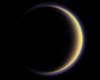
With its thick, distended atmosphere, Titan's orange globe shines softly, encircled by a thin halo of purple light-scattering haze. |
|
|

| The content herein, unless otherwise known to be public domain, are Copyright 1995-2006 - SpaceDaily.AFP and UPI Wire Stories are copyright Agence France-Presse and United Press International. ESA PortalReports are copyright European Space Agency. All NASA sourced material is public domain. Additionalcopyrights may apply in whole or part to other bona fide parties. Advertising does not imply endorsement,agreement or approval of any opinions, statements or information provided by SpaceDaily on any Web page published or hosted by SpaceDaily. Privacy Statement |