|
 |
 |
 |
 |
 |
 |
 |
 |

 |
Compact System Stabilizes Laser Frequency
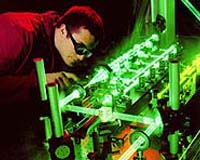
Boulder CO (SPX) Jul 28, 2005 A compact, inexpensive method for stabilizing lasers that uses a new design to reduce sensitivity to vibration and gravity 100 times better than similar approaches has been demonstrated by scientists at JILA in Boulder, Colo. JILA is a joint institute of the National Institute of Standards and Technology (NIST) and the University of Colorado at Boulder. The method, described in the July 15 issue of Optics Letters,* stabilizes laser light to a single frequency, so that it can be used as a reliable reference oscillator for technologies such as optical clocks and light-based radar (lidar). The new stabilizer design performs better than similar systems of comparable size and is much smaller and less expensive than the best-performing systems, according to physicist John Hall, a co-author of the paper. Laser systems are highly sensitive to environmental disturbances, such as electronic "noise" and vibration from soft drink vending machines or other equipment with mechanical motors. To stabilize operations in cases when high precision is needed, lasers are often "locked" to a single wavelength/frequency using an optical "cavity," a small glass cylinder with a mirror facing inward on each end. Laser light bounces back and forth between the mirrors and, depending on the exact distance between them, only one wavelength will "fit" that distance best and be reinforced with each reflection. Information from this stabilized laser light is then fed back to the laser source to keep the laser locked on this one frequency. But the cavity can vibrate, or expand in response to temperature changes, causing corresponding slight frequency changes. Researchers have tried various improvements such as using cavities made of low-expansion glass. In the latest advance, the JILA team made the cavity shorter and positioned it vertically instead of horizontally, with symmetrical mounting supports so that gravity and vibration forces yield opposing distortions in the two halves, and thus balance out to zero net effect. The system was demonstrated with an infrared laser. "We designed the cavity so it doesn't care if it's vibrating," says Hall, who helped develop a leading resonant cavity design two decades ago. "We get good performance with a complete reduction of complexity and cost." *M. Notcutt, L.S. Ma, J. Ye, and J.L. Hall. 2005. Simple and compact 1-Hz laser system via improved mounting configuration of a reference cavity. Optics Letters. July 15. Community Email This Article Comment On This Article Related Links National Institute of Standards and Technology SpaceDaily Search SpaceDaily Subscribe To SpaceDaily Express Space Technology News - Applications and Research
 LIGO Up And Running, But Gravity Waves Remain Elusive
 Washington DC (SPX) Jan 10, 2006
Scientists working on the Laser Interferometer Gravitational-Wave Observatory said Monday the facility has reached its target detection sensitivity, but the goal of finding the elusive phenomena known as gravity waves remains as elusive as ever. |
|
|

| The content herein, unless otherwise known to be public domain, are Copyright 1995-2006 - SpaceDaily.AFP and UPI Wire Stories are copyright Agence France-Presse and United Press International. ESA PortalReports are copyright European Space Agency. All NASA sourced material is public domain. Additionalcopyrights may apply in whole or part to other bona fide parties. Advertising does not imply endorsement,agreement or approval of any opinions, statements or information provided by SpaceDaily on any Web page published or hosted by SpaceDaily. Privacy Statement |