|
 |
 |
 |
 |
 |
 |
 |
 |

 |
Commentary: Remembering The Maine In Iraq
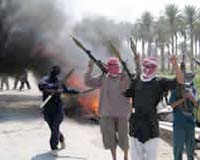
Washington (UPI) Sep 01, 2005 When the Iraqi insurgency reared its ugly head shortly after the collapse of the Saddam Hussein regime, Defense Secretary Rumsfeld reassured the home front this was like the harassment of allied positions in Germany after the collapse of Hitler's Third Reich. Just a few rearguard actions, the kind we dealt with in the immediate post-war days. By accident of birth, some of us served in World War II, and recall no such insurgency in Germany. The United States recruited important Nazis to help develop a strategic missile program and co-opted the Ghelen Organization, the department of Nazi intelligence that had focused on the Soviet Union. Still others hightailed out of Germany with Nazi loot - and Argentine passports. A German insurgency? A Nazi underground that targeted U.S. troops? That killed Germans cooperating with American occupation forces? No such animal. What did happen was Grand Admiral Karl Doenitz, appointed in Hitler's testament president of Germany, ordered all German forces to cease-fire May 8, 1945, and then holed up in Flensburg in an attempt to cobble together a post-war German government acceptable to the Americans and the British, while avoiding surrender to the Soviets. This was a far cry from the alleged terrorist attacks against U.S. troops described at the Pentagon when the Iraqi insurgency broke out. Now we have the claim that American troops fighting in Iraq are the modern-day moral equivalent of the struggle against Nazi fascism and Japanese imperialism. Hitler's legions had conquered all of Europe and reached the gates of Moscow before Pearl Harbor brought the United States into World War II. Prior to the sneak attack on Pearl Harbor, the Japanese war machine had rolled over large chunks of Asia, including Manchuria, north and central China. Before Pearl Harbor, Japan had also taken over French Indochina, used Vichy French bases to invade Thailand and Malaya, and attacked Hong Kong. Then, in quick succession, the Japanese war machine rolled over Burma, the Dutch East Indies (Indonesia), New Guinea and the Solomon Islands. Then 130,000 allied troops surrendered Singapore. On Dec. 11, 1941, Nazi Germany declared war on the United States, not the United States on Germany. How the example of Saddam's bloody one-man rule fits into the global geopolitical quilt of World War II is hard to discern. President Bush said the United States, both in World War II and now, had been the victim of a sneak attack. Conveniently overlooked is that the war in Iraq is only linked to Sept. 11, 2001, in the imaginative minds of the neo-con strategists who planned the invasion of Iraq. When the post-liberation scenario in Iraq went dangerously awry, speechwriters were directed to bone up on World War II and find appropriate analogies. There aren't any. Next to Adolf Hitler and Hideki Tojo, Saddam was a minor league dictator, albeit a bloodthirsty one, who was only a threat to his own people. His vaunted Republican Guard divisions doffed combat fatigues, donned body-length shirts and melted into the civilian population. The present fighting in Iraq finds no parallel in World War II. To suggest otherwise merely undermines the mission. The resistance movements in Nazi-occupied Europe forced Hitler to keep dozens of divisions on occupation duty. Hardly an apt parallel. What might qualify is the explosion that sank the USS Maine in Havana harbor March 21, 1898, and killed 267 crewmen, the incident that sparked the Spanish-American War. It was that era's equivalent of the Iraqi weapons of mass destruction controversy. William Randolph Hearst and Joe Pulitzer, precursors of today's neo-cons, accused Spain of atrocities and other human rights violations. The yellow press of its day and Congressional jingoes decided a Spanish mine had destroyed the Maine. In just three months, U.S. forces seized the Philippines, Guam and Puerto Rico. Independent Cuba became a de facto U.S. colony - a relationship that did not end until Fidel Castro's revolution six decades later. Who sank the Maine remained a mystery until Adm. Hyman G. Rickover, father of the U.S. nuclear navy, put experts to work on the case. Their 1976 report concluded the explosion was almost certainly caused by the "spontaneous combustion of coal in a bunker that abutted a powder magazine." Other experts concluded the Rickover report was flawed and concluded Spanish fanatics had set off a mine. It could also have been Cuban saboteurs. It was the wrong war at the wrong place - and left the United States lumbered with Cuba and the Philippines. This time the United States will have to carry a heavy burden in Iraq for a long time to come. Community Email This Article Comment On This Article Related Links SpaceDaily Search SpaceDaily Subscribe To SpaceDaily Express Iraq: The first technology war of the 21st century
 New Year Week Of Blasts In Baghdad
 Washington (UPI) Jan 10, 2006
The New Year started not merely with a bang in Iraq but with lots of them: A wave of renewed insurgent terror bombings drove civilian casualties sky high while increased fatalities were inflicted on U.S. combat forces. |
|
|

| The content herein, unless otherwise known to be public domain, are Copyright 1995-2006 - SpaceDaily.AFP and UPI Wire Stories are copyright Agence France-Presse and United Press International. ESA PortalReports are copyright European Space Agency. All NASA sourced material is public domain. Additionalcopyrights may apply in whole or part to other bona fide parties. Advertising does not imply endorsement,agreement or approval of any opinions, statements or information provided by SpaceDaily on any Web page published or hosted by SpaceDaily. Privacy Statement |