|
 |
 |
 |
 |
 |
 |
 |
 |

 |
Comet's Dust Clouds Hit NASA Spacecraft Like Thunderbolt
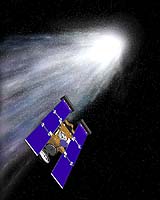
Chicago IL (SPX) Jun 21, 2004 Two swarms of microscopic cometary dust blasted NASA's Stardust spacecraft in short but intense bursts as it approached within 150 miles of Comet Wild 2 last January, data from a University of Chicago instrument flying aboard the spacecraft has revealed. "These things were like a thunderbolt," said Anthony Tuzzolino, a Senior Scientist at the University of Chicago's Enrico Fermi Institute. "I didn't anticipate running into this kind of show." Tuzzolino and Thanasis Economou, also a Senior Scientist at the Fermi Institute, will report their findings in the June 17 issue of the journal Science. The materials streaming from a comet range in size from particles that could fit on the head of a pin to boulders the size of a truck. Stardust mission planners correctly estimated that their spacecraft could safely avoid the hazardous larger objects by passing the comet at a distance of approximately 150 miles and using very effective dust particle shields. Based on the data collected by the Dust Flux Monitor Instrument, Tuzzolino and Economou estimate that NASA achieved its goal of collecting at least 1,000 samples measuring at least one-third the width of a human hair or larger during the flyby. The Stardust spacecraft is scheduled to return the samples to Earth in January 2006. Scientists will study the samples, the first ever returned to Earth from a comet, for insights into the early history of the solar system. The Dust Flux Monitor Instrument collected data for 30 minutes when the spacecraft passed closest to the comet last Jan. 2. Stardust encountered the first swarm of dust particles when the spacecraft passed within 146.5 miles of the comet's nucleus. The monitor detected a second intense swarm after passing the comet when the spacecraft was approximately 2,350 miles from the nucleus. "We believe that we see fragmentation of large dust lumps into swarms of small particles after they are coming out from the nucleus," Economou said. In between the particle swarms, the impact of which lasted just a few seconds each, the dust monitor went for periods of several minutes before it detected another particle. This isn't Tuzzolino's first encounter with a comet, though it is by far the closest. He helped design, build and test the Dust Counter and Mass Analyzer instrument that passed Comet Halley at a distance of 5,000 miles or more in 1986 aboard two Soviet Vega spacecraft. Halley had emitted a spray of dust "much smoother" than that of Wild 2, Tuzzolino recalled. "In general, one thinks of a comet as emitting gas and dust in a nice, uniform steady state, sort of like a hose," he said. Halley did show fluctuations, "but not to this extent." The dust monitor detected its first impact when Stardust was 1,010 miles from the cometary nucleus. The last impact was recorded at a distance of 3,500 miles as the spacecraft sped away. During one intense event, the dust monitor detected more than 1,100 impacts in one second. The largest particle measured during the cometary flyby measured an estimated 500ths of an inch in diameter. A similar instrument to the University of Chicago Dust Flux Monitor Instrument is a component on NASA's Cassini mission to Saturn. Cassini's High-Rate Detector, which Tuzzolino also built, is part of a larger instrument, Germany's Cosmic Dust Analyzer, which will study the ice and dust particles that form the major components of Saturn's ring system. Cassini is scheduled to become the first spacecraft ever to orbit Saturn on June 30. Community Email This Article Comment On This Article Related Links Stardust at JPL SpaceDaily Search SpaceDaily Subscribe To SpaceDaily Express Asteroid and Comet Mission News, Science and Technology
 Stardust Entry Path To Be Visible In Northwest
 Pasadena CA (JPL) Jan 10, 2006
On January 15, 2006, after more than 7 years and billions of miles of travel through space, NASA's Stardust spacecraft will release a 100-pound sample return capsule (SRC) to Earth with some precious cargo - pristine samples of comet and interstellar dust. |
|
|

| The content herein, unless otherwise known to be public domain, are Copyright 1995-2006 - SpaceDaily.AFP and UPI Wire Stories are copyright Agence France-Presse and United Press International. ESA PortalReports are copyright European Space Agency. All NASA sourced material is public domain. Additionalcopyrights may apply in whole or part to other bona fide parties. Advertising does not imply endorsement,agreement or approval of any opinions, statements or information provided by SpaceDaily on any Web page published or hosted by SpaceDaily. Privacy Statement |