|
 |
 |
 |
 |
 |
 |
 |
 |

 |
Comet Probes Reveal Evidence Of Origin Of Life
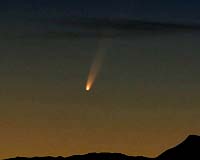
Cardiff, UK (SPX) Aug 17, 2007 Recent probes inside comets show it is overwhelmingly likely that life began in space, according to a new paper by Cardiff University scientists. Professor Chandra Wickramasinghe and colleagues at the University's Centre for Astrobiology have long argued the case for panspermia - the theory that life began inside comets and then spread to habitable planets across the galaxy. A recent BBC Horizon documentary traced the development of the theory. Now the team claims that findings from space probes sent to investigate passing comets reveal how the first organisms could have formed. The 2005 Deep Impact mission to Comet Tempel 1 discovered a mixture of organic and clay particles inside the comet. One theory for the origins of life proposes that clay particles acted as a catalyst, converting simple organic molecules into more complex structures. The 2004 Stardust Mission to Comet Wild 2 found a range of complex hydrocarbon molecules - potential building blocks for life. The Cardiff team suggests that radioactive elements can keep water in liquid form in comet interiors for millions of years, making them potentially ideal "incubators" for early life. They also point out that the billions of comets in our solar system and across the galaxy contain far more clay than the early Earth did. The researchers calculate the odds of life starting on Earth rather than inside a comet at one trillion trillion (10 to the power of 24) to one against. Professor Wickramasinghe said: "The findings of the comet missions, which surprised many, strengthen the argument for panspermia. We now have a mechanism for how it could have happened. All the necessary elements - clay, organic molecules and water - are there. The longer time scale and the greater mass of comets make it overwhelmingly more likely that life began in space than on earth." Community Email This Article Comment On This Article Related Links Cardiff University Life Beyond Earth Lands Beyond Beyond - extra solar planets - news and science
 Life Elsewhere In Solar System Could Be Different From Life As We Know It
 Washington DC (SPX) Jul 10, 2007
The search for life elsewhere in the solar system and beyond should include efforts to detect what scientists sometimes refer to as "weird" life -- that is, life with an alternative biochemistry to that of life on Earth -- says a new report from the National Research Council. The committee that wrote the report found that the fundamental requirements for life as we generally know it -- a liquid water biosolvent, carbon-based metabolism, molecular system capable of evolution, and the ability to exchange energy with the environment -- are not the only ways to support phenomena recognized as life. |
|
|

| The content herein, unless otherwise known to be public domain, are Copyright 1995-2007 - SpaceDaily.AFP and UPI Wire Stories are copyright Agence France-Presse and United Press International. ESA Portal Reports are copyright European Space Agency. All NASA sourced material is public domain. Additional copyrights may apply in whole or part to other bona fide parties. Advertising does not imply endorsement,agreement or approval of any opinions, statements or information provided by SpaceDaily on any Web page published or hosted by SpaceDaily. Privacy Statement |