|
 |
 |
 |
 |
 |
 |
 |
 |

 |
Comet Ahoy Off Venus At 7th-magnitude
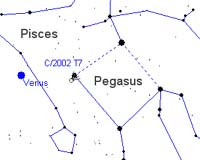
Huntsville - Feb 16, 2004 Comet C/2002 T7 is approaching Earth and brightening every day. It's not yet a naked-eye object, but the 7th-magnitude fuzzball is easy to see through backyard telescopes. The comet lies not far from brilliant Venus in the western sky after sunset. For the next three months, the comet will continue to brighten as it nears Earth. May 19th is the date of closest approach (0.27 AU). At that time C/2002 T7 might glow brighter than a 1st magnitude star--easily seen with the unaided eye. There remains considerable uncertainty about how bright this object will become. In May you'll have to be in the southern hemisphere to see it easily. Now is the best time for northern hemisphere observers to look, before the comet plunges south. Community Email This Article Comment On This Article Related Links More Pixs and Charts at Spaceweather.com SpaceDaily Search SpaceDaily Subscribe To SpaceDaily Express Asteroid and Comet Mission News, Science and Technology
 NASA'S Spitzer Finds Possible Comet Dust Around Dead Star
 Pasadena CA (SPX) Jan 12, 2006
NASA's Spitzer Space Telescope has spotted what may be comet dust sprinkled around the white dwarf star G29-38, which died approximately 500 million years ago.
--------------------------------------------------------- It's new. And it's downright terrific! Celestron's CPC Schmidt-Cassegrain telescope is the scope you've been waiting for! It offers new alignment technology, advanced engineering, and bold new design at a new, low price! In fact, Celestron's Professional Computerized (CPC) scope with revolutionary SkyAlign Alignment Technology redefines everything that amateur astronomers are looking for. It offers quick and simple alignment, GPS technology, unsurpassed optical quality, ease of use, advanced ergonomics, enhanced computerization and, most important, affordability. Want to view M-31 tonight? One button takes you there!
Shop for telescopes online at Telescopes.com! today!
|
|
|

| The content herein, unless otherwise known to be public domain, are Copyright 1995-2006 - SpaceDaily.AFP and UPI Wire Stories are copyright Agence France-Presse and United Press International. ESA PortalReports are copyright European Space Agency. All NASA sourced material is public domain. Additionalcopyrights may apply in whole or part to other bona fide parties. Advertising does not imply endorsement,agreement or approval of any opinions, statements or information provided by SpaceDaily on any Web page published or hosted by SpaceDaily. Privacy Statement |