|
 |
 |
 |
 |
 |
 |
 |
 |

 |
Cold Polar Rings Help Form Clouds That Destroy Ozone
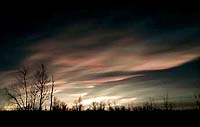
Moffett Field - March 29, 2001 Newly discovered, narrow rings of cold air over Earth's poles help form colorful clouds that destroy ozone, according to a technical paper that will appear in the March 30 issue of the journal Science. The ozone layer protects life on Earth from the sun's harmful ultraviolet radiation that could cause skin cancer in human beings and biological damage to living things. The paper's authors believe they have solved a decade-old mystery of how glowing, ozone-destroying clouds that contain nitric acid and water form road-dust-size particles that later spread to decompose ozone. "Large polar stratospheric cloud (PSC) particles are born inside narrow temperature rings around Earth's poles in absolute darkness," according to Azadeh Tabazadeh, lead author of the paper and a scientist at NASA's Ames Research Center in California's Silicon Valley. "Strong winds blow these special clouds away from the cold rings to fill the polar air with ozone-destroying particles. The areal extent of these clouds is often larger than the United States despite the fact that the clouds initially form inside a narrow temperature ring," she said. The other authors of the paper are Eric Jensen and Katja Drdla, both of Ames; Brian Toon from the University of Colorado, Boulder; and Mark Schoeberl of NASA's Goddard Space Flight Center, Greenbelt, MD. The PSCs form in the stratosphere, the part of Earth's atmosphere between about 9 and 30 miles (about 12 to 40 kilometers) altitude, which includes the ozone layer. The cold rings (about minus120 degrees F., or minus 83 degrees C.) where PSCs form, circle both poles at an altitude of 12 to 20 miles (15 to 26 kilometers). Known for their colorful glows, PSCs provide surfaces that convert benign forms of chlorine into reactive, ozone-destroying forms. The large particles in PSCs also remove nitrogen compounds from the air, a process called "denitrification." Nitrogen compounds in the atmosphere normally moderate the destructive impact of chlorine on ozone. "An ozone hole forms every spring over the Antarctic in the Southern Hemisphere which is colder than the Arctic," said Tabazadeh. Increased denitrification over the Antarctic can cause the area of the "ozone hole" there to increase, according to the authors. Last year, a NASA satellite measured the largest ozone hole ever over the Antarctic, Tabazadeh said. "It is possible that the area of the Antarctic ozone hole may spread even farther than that measured last winter before the hole recedes to what it was in the 1970s," she added. "On the other hand, the warmer Arctic climate in the north is becoming colder, more like the Antarctic in the south. This could lead to more dramatic ozone loss in the future over the Northern Hemisphere, where many people live," Tabazadeh said. The authors report that NASA satellite observations for the first time showed widespread denitrification as high as 20 percent to 50 percent in the Arctic stratosphere during the 1999-2000 winter. "Increased denitrification in the Arctic can delay the recovery of the ozone layer despite the fact that ozone-destroying chlorofluorocarbon (CFC) levels are declining in the atmosphere due to international agreements," Tabazadeh said. More than a decade ago, scientists determined that human-made chlorine and bromine compounds cause most ozone depletion. Manufacturers made the chlorine compounds, "CFCs," for use as refrigerants, aerosol sprays, solvents and foam-blowing agents. Fire fighters used bromine-containing halogens to put out fires. Manufacture of CFCs ceased in 1996 in signatory countries under the terms of the Montreal Protocol and its amendments. "Scientists used to believe that as chlorine levels decline in the upper atmosphere, the ozone layer should slowly start to recover. However, greenhouse gas and soot emissions, which provide warming at the Earth's surface, lead to cooling in the upper atmosphere. This cooling promotes formation of more clouds that destroy ozone," Tabazadeh added. Community Email This Article Comment On This Article Related Links University of Colorado Aerosol Research Group SpaceDaily Search SpaceDaily Subscribe To SpaceDaily Express Dirt, rocks and all the stuff we stand on firmly
 Environmental Damage Threatens Human Health
 Bangkok (AFP) Dec 9, 2005
Environmental damage threatens human health and may have contributed to the spread of new diseases like bird flu and SARS, the World Health Organization said in a report Friday. |
|
|

|
|
|
|
|
|
|
|
|
|
|
|
| The content herein, unless otherwise known to be public domain, are Copyright 1995-2006 - SpaceDaily.AFP and UPI Wire Stories are copyright Agence France-Presse and United Press International. ESA PortalReports are copyright European Space Agency. All NASA sourced material is public domain. Additionalcopyrights may apply in whole or part to other bona fide parties. Advertising does not imply endorsement,agreement or approval of any opinions, statements or information provided by SpaceDaily on any Web page published or hosted by SpaceDaily. Privacy Statement |