|
 |
 |
 |
 |
 |
 |
 |
 |

 |
Cohen Says NMD Test Failure "Not Fatal"
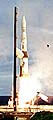
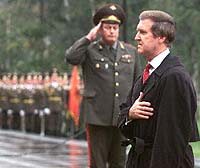
Elmendorf AFB (AFP) July 10, 2000 - US Defense Secretary William Cohen said Monday the failure of a national missile defense test was "not fatal" and indicated he may recommend deploying it anyway. Cohen said he would await a full report of Saturday's NMD test before making his recommendation to President Bill Clinton, who is expected to decide this summer whether to go ahead with construction of the first phase of the system. The crucial missile intercept attempt went awry when the "kill vehicle" that is used to search and destroy an incoming warhead failed to separate from the second stage of the interceptor missile. Calling it a "disappointment," Cohen stressed that the failure involved routine booster separation and not the more sophisticated technologies devised to steer the kill vehicle into a collision with a warhead in space. "That's something that's not fatal to the program, and so I would reserve the judgment until I get all the way through the analysis," he told reporters. Since the kill vehicle never performed its intended search and destroy mission, the test yielded no information on whether it can find a warhead in space, distinguish it from a decoy and collide with it. Of three attempted interceptions, two have now failed, falling short of the Pentagon's own minimum criteria of scoring two intercepts before declaring the system ready for deployment in 2005. "It would have been desirable to have two successful intercepts, but it doesn't mean the technology is not there yet," he said. "I still could make a recommendation. I just have to sit down and review all of the information." Cohen brushed aside suggestions that the three tests so far do not provide enough information on which to base a decision. "Don't forget we get at least another 12 to 15 more tests before a system would actually be deployed," he said. Democrats and Republicans have urged Clinton to leave the deployment decision to his successor. Cohen said he has not spoken to the president about the test. The secretary made the comments as he flew to Beijing for a four-day visit aimed at mending defense ties that were ruptured last year by the US bombing of the Chinese embassy in Belgrade. His talks were expected to highlight both China's vehement opposition to US missile defense plans and American concerns about reported Chinese aid to Pakistan's missile program. Despite Saturday's test failure, Cohen said he will tell the Chinese the United States will continue developing theater and national missile defenses because of the threat posed by missile proliferation. "There continues to be an evolving threat," he said. "Whether it comes in 2005 or sooner or later, the spread of this technology will pose a risk to the United States." "We will always depend upon deterrence, that will be our very first line of defense, and yes, we will send a signal to every country that should they ever launch a missile at the United States, they will pay a very serious consequence as a result of it," he said. "But what I have tried to point out is that we never want to have the United States put in the position of being blackmailed, and prevented from carrying out our security interests in a conventional way," he said. The NMD program has been driven by US intelligence estimates that North Korea is likely to have long-range missiles capable of striking the United States by 2005. If Clinton does not give the go ahead this year for the start of construction of the first piece of the NMD system -- a high frequency radar on Shemya island in Alaska -- the Pentagon will be unable to deploy the system by 2005, Pentagon officials said. The US intelligence community is currently conducting a new assessment to reflect changes in the threat outlook, including North Korea's suspension of flight tests of its long-range missiles and its rapprochement with the South. But Cohen said North Korea could resume testing at any time, or threaten to do so depending on how its relations with South Korea are progressing. "We cannot adjust, or calibrate whether or not we go forward with an NMD program based upon what the North Koreans may say from time to time," he said. "I think it's clear based upon what they have done in the past, they could achieve a long range capability by 2005."
|
Washington (AFP) July 9, 2000 - President Bill Clinton's decision on deploying a national missile defense system will weigh a recent test failure as an "important" factor, his national security advisor, Samuel Berger, said Sunday. "Clearly the failure of the test on Saturday is important in assessing how far along this system is technologically ... Obviously, this does go to the question of technical feasibility," Berger said on the CBS program "Face The Nation." Technical feasibility, Berger noted, is one of the four key criteria that Clinton has said he will consider in deciding whether to deploy a missile defense system. On Saturday, White House spokesman PJ Crowley said it was too soon to know how the latest test might affect Clinton's decision. The other three criteria, Berger said, include the nature of the missile threat against which the system is to defend, the cost of building the system and the "overall impact of such a system on our security, including arms control." Regarding the nature of the missile threat, Berger said Clinton would consider "how serious" and "how advanced" it is. The Pentagon has estimated the cost of an anti-missile shield to be some 60 billion dollars, though some experts say it may cost more. The cost of the test conducted Saturday, in which one missile failed to intercept another over the Pacific Ocean, has been estimated at 100 million dollars. "We will now wait for an assessment by the Defense Department over the next few weeks ... and then sometime this summer the president will make a decision whether to deploy this system or whether to defer that for a later point," Berger said. He said input from other members of the president's cabinet, including Secretary of State Madeleine Albright, would also go into Clinton's decision. Asked whether the botched missile interception might sway Clinton to postpone decision on the anti-missile shield, Berger reiterated that the test failure was "clearly" relevant to "the question of technical feasibility" but declined to pre-judge what Clinton would decide. "He will look at all of those factors that I mentioned," said Berger. India Vehemently Condemns US Missile Defense Test New Delhi (AFP) July 9, 2000 - Indian Foreign Minister Jaswant Singh on Sunday condemned the "militarisation of space" and a new arms race by the United States following its missile interception test on Saturday. Jaswant Singh told state-run Doordarshan television that the act would trigger a new arms race among the great powers and damage the overall global disarmament process. "The Minuteman intercontinental missile defence programme of the United States will without doubt have a consequence which will be damaging to the overall approach to disarmament," Singh told Doordarshan. "We do not support the militarisation of outer space," said Singh, expressing serious concerns about the negative impact exerted by the US development of the national missile defense (NMD) system. "It deviates from the path of de-weaponisation and will lead to an enhancement of weapons. It runs counter to their own philosophy of moving from step one to two... to three and a gradual reduction of the vast armoury of weapons of mass destruction," said Singh.
|
 Memory Foam Mattress Review |
Newsletters :: SpaceDaily :: SpaceWar :: TerraDaily :: Energy Daily XML Feeds :: Space News :: Earth News :: War News :: Solar Energy News |
 Satellite Launch To Boost DTH In India
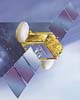 Calcutta, India (SPX) Dec 28, 2005
|
|

|
|
|
|
|
|
|
|
|
|
|
|
| The content herein, unless otherwise known to be public domain, are Copyright 1995-2006 - SpaceDaily.AFP and UPI Wire Stories are copyright Agence France-Presse and United Press International. ESA PortalReports are copyright European Space Agency. All NASA sourced material is public domain. Additionalcopyrights may apply in whole or part to other bona fide parties. Advertising does not imply endorsement,agreement or approval of any opinions, statements or information provided by SpaceDaily on any Web page published or hosted by SpaceDaily. Privacy Statement |