|
 |
 |
 |
 |
 |
 |
 |
 |

 |
Cohen Leaps Into ABM Frying Pan
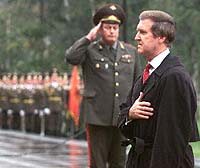
Moscow (AFP) June 12, 2000 - by Jim Mannion Moscow (AFP) June 12, 2000 - US Defense Secretary William Cohen arrived here Monday to engage Russia head-on in a debate over rival US and Russian missile defense plans as both countries vie for support in Europe. President Vladimir Putin, who floated a suprise Russian proposal for a European missile defense system June 5 in Rome, was expected to meet Tuesday with Cohen, US officials said. The defense secretary also will talk to Russian Defense Minister Igor Sergeyev and members of parliament. He was hosting a dinner Monday night for a group of Russian policy makers, thinkers on security policy, and chess master Gary Kasparov, officials said. Flying here from Stockholm, Cohen told reporters he would be seeking details about Russia's idea for a joint missile defense system that would protect Europe without violating the 1972 Anti-Ballistic Missile Treaty. "So far it is a very vague concept that has no defined parameters, and so it's hard for me to have a responsible comment on it until I know more about it," he said. It was still unclear whether the Russians were proposing defenses against only short and medium range missiles, or also against the long-range missiles that Washington sees as the coming threat, he said. "But based on what I've heard to date, this concept doesn't really do the mission that we're concerned with," he said. Cohen said "there are a lot of questions floating around." If Russia is proposing a system to intercept long-range missiles in their ascent or "boost phase", it would require changes to the anti-ballistic missile system, he said. On the other hand, if it envisions using theater missile defenses to shoot down incoming missiles, large parts of Europe and all of the United States would remain unprotected, he said. Russia meanwhile adamantly opposes US plans for a national missile defense (NMD) to protect US territory, saying it would upset the nuclear balance and ignite a nuclear arms race. The United States wants Russia to agree to changes in the 1972 Anti-Ballistic Missile treaty that would allow deployment of a limited NMD system. But Putin has refused and instead has countered with a diplomatic offensive to tout his own European-centered plan and warn that the US anti-missile plan was a grave miscalculation. The American project "would lead to the destruction of the stable basis represented by the 1972 ABM accord," Putin said in an interview Sunday with the German newspaper Welt am Sonntag. Cohen acknowledged that the European allies, whose support will be needed to mount tracking radars for the US system, have "genuine concerns about the NMD system itself". But he said he did not believe the Russian proposal had had much impact on the Europeans. The 60-billion dollar US national missile defense program, meanwhile, has come under fire in the United States as technologically unfeasible. A scientist from the Massachusetts Institute of Technology (MIT) charged that tests were rigged to hide the fact that the system cannot distinguish between a warhead and a simple decoy. But Cohen said: "We believe that the testing to date demonstrates the validity that we are close to having a technology that can in fact defeat a few dozens of missiles fired by a rogue state." The other thorny issue up for discussion during Cohen's visit will be the prospect of further NATO enlargement eastwards that could include the Baltics. Cohen called Saturday for expanded engagement with Russia to ease its suspicions, at a meeting with Nordic defense ministers in Vilnius, while stressing Russia did not "have a veto over NATO decisions". But in his interview, Putin reiterated Moscow's warnings against the three former Soviet Baltic states, Latvia, Lithuania and Estonia joining the western alliance. Eastward extension of NATO would not favour European stability, and would have "very serious consequences for the continent's entire security system," Putin said.
|
by Jim Mannion Moscow (AFP) June 12, 2000 - US Defense Secretary William Cohen arrived here Monday eager for details about a Russian proposal for a European missile defense system but deeply skeptical about its substance. President Vladimir Putin, who floated the suprise proposal June 5 in Rome, was expected to meet Tuesday with Cohen, US officials said. The defense secretary also will talk to his Russian counterpart, Igor Sergeyev, and members of the Russian parliament. "So far it is a very vague concept that has no defined parameters, and so it's hard for me to have a responsible comment on it until I know more about it," Cohen told reporters as he flew here from Stockholm. It was still unclear whether the Russians were proposing defenses against only short and medium range missiles, or also against the long-range missiles that Washington sees as the coming threat, he said. "But based on what I've heard to date, this concept doesn't really do the mission that we're concerned with," he said. Cohen said "there are a lot of questions floating around." If Russia is proposing a system to intercept long-range missiles in their ascent or "boost phase", it would require changes to the anti-ballistic missile system, he said. On the other hand, if it envisions using theater missile defenses to shoot down incoming missiles, large parts of Europe and all of the United States would remain unprotected, he said. Russia meanwhile adamantly opposes US plans for a national missile defense (NMD), saying it would upset the nuclear balance and ignite a nuclear arms race. The United States wants Russia to agree to changes in the 1972 Anti-Ballistic Missile treaty that would allow deployment of a limited NMD system, but Putin has refused. In an interview on Sunday with the German newspaper Welt am Sonntag, Putin warned that the US missile defense plan was a grave strategic miscalculation. The American project "would lead to the destruction of the stable basis represented by the 1972 ABM accord", Putin said. Cohen acknowledged that the European allies, whose support will be needed to mount tracking radars for the US system, also have "genuine concerns about the NMD system itself". But he said he did not believe the Russian proposal had had much impact on the Europeans. The 60-billion dollar US national missile defense program, meanwhile, has also come under fire at home as technologically unfeasible. A scientist from the Massachusetts Institute of Technology (MIT) charged this week that tests were rigged to hide the fact that the system cannot distinguish between a warhead and a simple decoy. "We believe that the testing to date demonstrates the validity that we are close to having a technology that can in fact defeat a few dozens of missiles fired by a rogue state," Cohen said. The other thorny issue up for discussion during Cohen's visit will be the prospect of further NATO enlargement eastwards that could include the Baltics. Cohen called Saturday for expanded engagement with Russia to ease its suspicions, at a meeting with Nordic defense ministers in Vilnius, while stressing Russia did not "have a veto over NATO decisions". But in his interview, Putin reiterated Moscow's warnings against the three former Soviet Baltic states, Latvia, Lithuania and Estonia joining the western alliance. Eastward extension of NATO would not favour European stability, and would have "very serious consequences for the continent's entire security system", Putin said. A senior group of US Congressmen specialised in Russian policy was also accompanying Cohen on his visit to Moscow.
|
 Memory Foam Mattress Review |
Newsletters :: SpaceDaily :: SpaceWar :: TerraDaily :: Energy Daily XML Feeds :: Space News :: Earth News :: War News :: Solar Energy News |
 Satellite Launch To Boost DTH In India
 Calcutta, India (SPX) Dec 28, 2005
|
|

|
|
|
|
|
|
|
|
|
|
|
|
| The content herein, unless otherwise known to be public domain, are Copyright 1995-2006 - SpaceDaily.AFP and UPI Wire Stories are copyright Agence France-Presse and United Press International. ESA PortalReports are copyright European Space Agency. All NASA sourced material is public domain. Additionalcopyrights may apply in whole or part to other bona fide parties. Advertising does not imply endorsement,agreement or approval of any opinions, statements or information provided by SpaceDaily on any Web page published or hosted by SpaceDaily. Privacy Statement |