|
 |
 |
 |
 |
 |
 |
 |
 |

 |
Cluster Quartet Ready For Commissioning
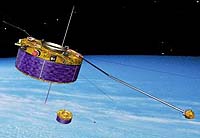
Paris - August 21, 2000 - With the four Cluster spacecraft safely assembled in their operational polar orbits, and the rigid booms (two experiment booms and one antenna boom for each spacecraft) deployed, the instrument commissioning phase is now about to get under way. Project Scientist Philippe Escoubet is enthusiastically looking forward to getting the suite of 44 scientific instruments up and running. "Once the major orbital manoeuvres were completed on 15 August and the spacecraft's main engines were no longer needed, our first step was to open the covers of the ASPOC and CIS instruments on Rumba and Tango so that we could allow them to outgas and ensure that they did not become stuck in position," he said. Philippe explained that, for the next few months, the instruments will be brought gradually to life. During this period they will stay inside the Earth's magnetosphere and travel into the extended magnetotail, almost one third of the way to Moon. "We are now carrying out a series of minor trim and drift manoeuvres to set up the spacecraft's tetrahedral formation," he said. "These small orbital alterations are carried out a few hours after perigee (their closest orbital point to the Earth). The tetrahedral pattern will be required for detailed 3-D studies of the different regions in the magnetosphere. "On 22 August, we shall start to switch on the scientific instruments by sending up commands from the ground stations at VILSPA (Spain) and Canberra (Australia). We switch on the same instrument on each spacecraft, one after the other. "We have chosen to switch on FGM (one of the magnetometers) first, since all of the other instruments rely on its data. This means we first had to deploy the two 5 metre-long rigid booms that are used by FGM and STAFF. "Then we begin to operate the other instruments over a period of about three months. During this time we will gradually go through a series of checks of the electronics and the sensors. We also deploy the sixteen 50-metre wire booms (four on each spacecraft) to their full length in four gentle stages. "VILSPA will handle the calibration and check-out of ASPOC, EDI and the five wave experiments, while Canberra will deal with the other three particle instruments." Important though all of this calibration and evaluation is, Philippe has to admit that he cannot wait for the first real scientific data from the Cluster flotilla. "By early December, we should have all 44 instruments on the four spacecraft operational. At that time, there will be the first crossing of the magnetopause -- the boundary between interplanetary space, which is dominated by the solar wind, and the Earth's magnetic field. Then, in late February 2001, we will start to investigate the Earth's polar cusps. "This will be an exciting time for the international science community. Cluster involves more than 70 labs and over 250 scientists from many countries, including Europe, the United States, Russia, China, Japan and Israel. Some of these have been working on the mission for 15 years." With a look of eager anticipation, he concluded, "We're all looking forward to analysing a flood of data over the next two years!"
Cluster Instrument Sites
Email This Article Comment On This Article Related Links Space
 Satellite Launch To Boost DTH In India
 Calcutta, India (SPX) Dec 28, 2005
The successful launch Thursday of India's heaviest satellite from spaceport of Kourou in French Guyana may have boosted the country's space research efforts to yet another level, but it has also lifted the spirits of at least three Direct-To-Home televisions broadcasters, one of which has been waiting for years to launch its services in India. |
|
|

|
|
|
|
|
|
|
|
|
|
|
|
| The content herein, unless otherwise known to be public domain, are Copyright 1995-2006 - SpaceDaily.AFP and UPI Wire Stories are copyright Agence France-Presse and United Press International. ESA PortalReports are copyright European Space Agency. All NASA sourced material is public domain. Additionalcopyrights may apply in whole or part to other bona fide parties. Advertising does not imply endorsement,agreement or approval of any opinions, statements or information provided by SpaceDaily on any Web page published or hosted by SpaceDaily. Privacy Statement |