|
 |
 |
 |
 |
 |
 |
 |
 |

 |
Cluster Locates Source Of Non-Thermal Terrestrial Continuum Radiation
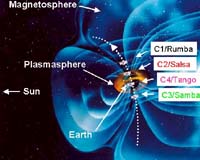
Paris (ESA) Sep 20, 2004 Published 14 July 2004, in Annales Geophysicae, a multipoint analysis of Cluster data allows, for the first time, to locate the source of non-thermal terrestrial continuum radiation by triangulation. This study also reveals the importance of small-scale density irregularities in the local amplification of these radiations, which triggers the need of more detailed generation and propagation models. Sources of Non-Thermal terrestrial Continuum radiation (NTC) have been found in the plasmapause region, by triangulation of observations from the Cluster satellites. This result is among a wealth of observational advances in the study of NTC, detailed in a recent paper published in Annales Geophysicae. The term continuum refers to radiation banded in frequency, displaying spectral stability in intensity, over a typical time scale of several hours. Over the last 30 years, NTC radiation has been observed not only in the Earth environment but also from the magnetosphere of Jupiter, Saturn, Uranus and Neptune; in other words, from all planets of our Solar system with a strong magnetic field. NTC is one of the two primary types of coherent radio emissions observed from Planetary magnetospheres. One type (for example terrestrial auroral kilometric radiation, jovian hectometric radiation) is intense and bursty, the other (NTC) weaker and long lasting. NTC results from the mode conversion of electrostatic waves to electromagnetic waves. Even if different theories of mode conversion have been proposed, the generation, the amplification and the propagation of NTC remain open questions. All these questions are linked to the source location(s) of NTC. On Cluster, NTC is observed in a variety of magnetospheric regions (Image 2). These include: the solar wind, the magnetosheath (top panel), the magnetotail (middle panel) and the inner magnetosphere (bottom panel). Past observations led to the conclusion that the source of NTC may not be unique but multiple, originating from the plasmapause region, mainly in the equatorial plane. Additionally, according to one of the two main theories of mode conversion (Jones, 1976), the magnetopause may also be a possible source region (Jones, 1987). Using the unique space fleet configuration of Cluster, the position of NTC sources have been identified, for the first time, by triangulation (see below for more information on triangulation). Each time, NTC was found originating from the plasmapause region (Image 3), but sometimes out of the equatorial plane (Image 4). "The classical view of a source placed both at the plasmapause and at the equator is ruled out", wrote Dr. P. Decreau, PI of the Cluster relaxation sounder (WHISPER**) and lead author on this research, published 14 July 2004 in Annales Geophysicae. Another interesting finding is the observation of NTC amplification in the presence of local density depletions of small size (Image 5). These observations suggest a possible role of small-scale irregularities on radiation properties of NTC, including propagation path. This finding triggers the need of more refined models. More observational advances on NTC are foreseen in the coming years, thanks to the large spacecraft separations foreseen: "Triangulation at large distance from the source would help to reduce the estimated angular dimension of the source region. Triangulation for instance from the magnetosheath is not yet possible but should be done during the future mission phases (2005 onwards), when large spacecraft separations are foreseen", Decreau added.
Triangulation- Direction finding analysis The electric field intensity of NTC detected by WHISPER on each Cluster spacecraft shows a pronounced modulation caused by the rotation of the electric antenna. This property is used to determine the direction of propagation, projected into the plane of rotation of the antenna (spin plane).
Locating source regions For each individual spacecraft, a direction finding analysis is performed at a given frequency and for a given short time period (for example 30 seconds) where the continuum radiation occurs. This analysis is repeated for successive time periods. The source is thus located where the directions are intersecting (Image 3). However, this analysis provides only a 2D view of the source location; the view of sources projected into the XY GSE plane, parallel to the spin planes. Under the assumption of stability of the location of the source region, directions measured even at a limited precision can lead to a plausible triangulation (Image 6), again to be considered as the projection of the source in a plane. Community Email This Article Comment On This Article Related Links Cluster SpaceDaily Search SpaceDaily Subscribe To SpaceDaily Express Dirt, rocks and all the stuff we stand on firmly
 Magnetic Reconnection Region Larger Than 2.5 Million Km Found In The Solar Wind
 Paris (ESA) Jan 12, 2006
Using the ESA Cluster spacecraft and the NASA Wind and ACE satellites, a team of American and European scientists have discovered the largest jets of particles created between the Earth and the Sun by magnetic reconnection. This result makes the cover of this week's issue of Nature. |
|
|

| The content herein, unless otherwise known to be public domain, are Copyright 1995-2006 - SpaceDaily.AFP and UPI Wire Stories are copyright Agence France-Presse and United Press International. ESA PortalReports are copyright European Space Agency. All NASA sourced material is public domain. Additionalcopyrights may apply in whole or part to other bona fide parties. Advertising does not imply endorsement,agreement or approval of any opinions, statements or information provided by SpaceDaily on any Web page published or hosted by SpaceDaily. Privacy Statement |