|
 |
 |
 |
 |
 |
 |
 |
 |

 |
Clues To Early History Of Solar System's Oldest Diamonds
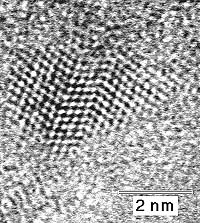
Munich - August 09, 2001 Simulating implantation of noble gases into terrestrial diamond grains, scientists from the Karpov Institute for Physical Chemistry (Moscow, Russia) and the Max Planck Institute for Chemistry (Mainz, Germany) infer a sequence of events in the early life of diamonds in meteorites, the most common form of stardust available for laboratory study (Nature, August 9, 2001). A most exciting event in the study of meteorites has been the discovery that many primitive meteorites contain stardust -- grains of presolar origin, older than the Solar System itself. Formed as circumstellar grains around dying stars, and having survived all subsequent events in the interstellar medium and in the Solar System, they carry information about the processes by which chemical elements are created in stars (nucleosynthesis). In turn, from our concepts about nucleosynthesis we can infer the stellar sources of the grains. Complementing previous analyses of stardust diamonds by the Max Planck group, scientists from the Karpov Institute of Physical Chemistry and from the Max Planck Institute for Chemistry have studied the introduction of diagnostic trace elements into terrestrial analog diamonds. The results are used to draw conclusions about the early history of "stellar diamonds" (Nature, August 9, 2001). Presolar grains known to be present in meteorites are thermally and chemically extremely stable minerals such as diamond, graphite, silicon carbide, corundum (aluminum oxide) and silicon nitride. Although discovered first and by far the most abundant (ca. 1 per mill by weight in the most primitive meteorites), the diamonds are the least understood, and their very identification as being presolar is based on the isotopic composition of trace elements they carry. Noble gases have played a special role among these trace elements, and it is primarily the unusual isotopic composition of xenon -- ca. 100% enrichment of the lightest and heaviest isotopes -- which suggests that they came from supernova explosions. How, when, and where introduction of xenon and other trace elements occurred may provide crucial information on formation and early history of the diamond grains, and there are strong indirect arguments that introduction was by implantation of ions. To test the viability of the process, a simulation experiment was performed: a noble gas mixture consisting of helium, argon, krypton and xenon ions with an energy of 700 electronvolts was implanted into a layer of terrestrial nanodiamonds of similar size as the presolar nanodiamonds (extremely small, only a few nanometer; see figure), and after irradiation the release of the implanted noble gases was studied. Surprisingly, release as a function of temperature was bimodal, with one peak in the 200-700 C range and another one above 1000 C. This situation -- after a single implantation -- at first glance is similar to the case of the meteoritic nanodiamonds, there is a complication, however. In the case of the "stellar" diamonds differences in isotopic composition demand that at least two different events must have been involved in the introduction of noble gases: isotopically unremarkable noble gases are released primarily at low temperature, gases of presumably supernova origin at higher temperature. If indeed, ion implantation is the mechanism by which trace elements were introduced into stardust diamonds and if, as the simulation study suggests, ion implantation results in the gases being located in two different sites within the diamonds of different thermal stability, the following sequence of events seems required:
How this may have affected the inferred abundance and isotopic composition of the supernova implants into the stardust diamonds and how important the resulting changes are for the inferred nuclear processes remains to be worked out in detail. Community Email This Article Comment On This Article Related Links Max Planck Institute for Chemistry SpaceDaily Search SpaceDaily Subscribe To SpaceDaily Express Dirt, rocks and all the stuff we stand on firmly
 Magnetic Reconnection Region Larger Than 2.5 Million Km Found In The Solar Wind
 Paris (ESA) Jan 12, 2006
Using the ESA Cluster spacecraft and the NASA Wind and ACE satellites, a team of American and European scientists have discovered the largest jets of particles created between the Earth and the Sun by magnetic reconnection. This result makes the cover of this week's issue of Nature. |
|
|

|
|
|
|
|
|
|
|
|
|
|
|
| The content herein, unless otherwise known to be public domain, are Copyright 1995-2006 - SpaceDaily.AFP and UPI Wire Stories are copyright Agence France-Presse and United Press International. ESA PortalReports are copyright European Space Agency. All NASA sourced material is public domain. Additionalcopyrights may apply in whole or part to other bona fide parties. Advertising does not imply endorsement,agreement or approval of any opinions, statements or information provided by SpaceDaily on any Web page published or hosted by SpaceDaily. Privacy Statement |