
 |
 |
 |
 |
 |
 |
 |
 |
 |

 |
Closing The Gap Between Fish And Land Animals
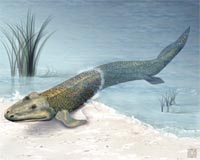
Uppsala, Sweden (SPX) Jul 02, 2008 New exquisitely preserved fossils from Latvia cast light on a key event in our own evolutionary history, when our ancestors left the water and ventured onto land. Swedish researchers Per Ahlberg and Henning Blom from Uppsala University have reconstructed parts of the animal and explain the transformation in the new issue of Nature. It has long been known that the first backboned land animals or "tetrapods" - the ancestors of amphibians, reptiles, birds and mammals, including ourselves - evolved from a group of fishes about 370 million years ago during the Devonian period. However, even though scientists had discovered fossils of tetrapod-like fishes and fish-like tetrapods from this period, these were still rather different from each other and did not give a complete picture of the intermediate steps in the transition. In 2006 the situation changed dramatically with the discovery of an almost perfectly intermediate fish-tetrapod, Tiktaalik, but even so a gap remained between this animal and the earliest true tetrapods (animals with limbs rather than paired fins). Now, new fossils of the extremely primitive tetrapod Ventastega from the Devonian of Latvia cast light on this key phase of the transition. "Ventastega was first described from fragmentary material in 1994; since then, excavations have produced lots of new superbly preserved fossils, allowing us to reconstruct the whole head, shoulder girdle and part of the pelvis", says Professor Per Ahlberg at the Department of Physiology and Developmental Biology, Uppsala University. The recontructions made by Professor Ahlberg and Assistant Professor Henning Blom together with British and Latvian colleagues show that Ventastega was more fish-like than any of its contemporaries, such as Acanthostega. The shape of its skull, and the pattern of teeth in its jaws, are neatly intermediate between those of Tiktaalik and Acanthostega. "However, the shoulder girdle and pelvis are almost identical to those of Acanthostega, and the shoulder girdle is quite different from that of Tiktaalik (the pelvis of Tiktaalik is unknown), suggesting that the transformation from paired fins to limbs had already occurred. It appears that different parts of the body evolved at different speeds during the transition from water to land", says Per Ahlberg. Community Email This Article Comment On This Article Share This Article With Planet Earth
Related Links Uppsala University Darwin Today At TerraDaily.com
 Passports For Penguins
 Bristol, UK (SPX) Jul 02, 2008
Ground-breaking technology that will enable biologists to identify and monitor large numbers of endangered animals, from butterflies to whales, without being captured, will be shown to the public for the first time at this year's Royal Society Summer Science exhibition [30 June to 3 July]. |
|
|

| The content herein, unless otherwise known to be public domain, are Copyright 1995-2007 - SpaceDaily.AFP and UPI Wire Stories are copyright Agence France-Presse and United Press International. ESA Portal Reports are copyright European Space Agency. All NASA sourced material is public domain. Additional copyrights may apply in whole or part to other bona fide parties. Advertising does not imply endorsement,agreement or approval of any opinions, statements or information provided by SpaceDaily on any Web page published or hosted by SpaceDaily. Privacy Statement |
 del.icio.us
 Digg
Digg Reddit
 YahooMyWeb
 Google
 Facebook