|
 |
 |
 |
 |
 |
 |
 |
 |

 |
Clinton Leaves Missile Shield Deployment To Successor
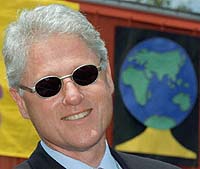
Washington (AFP) September 1, 2000 - US President Bill Clinton said Friday he would leave to his successor a decision on whether to deploy a controversial national missile shield that many fear may spark a new arms race. Clinton said that although some initial tests of parts of the system were "promising," much more information was needed before he could responsibly make a decision to commit the billions of dollars needed to deploy national missile defense (NMD). "Though the technology for national missile defense is promising, the system as a whole is not yet proven," Clinton said in a speech to students at Georgetown University here. "There is a reasonable chance that all these challenges can be met in time, but I simply cannot conclude, with the information I have today, that we have enough confidence in the technology and the operational effectiveness of the entire NMD system to move forward to deployment. "Therefore, I have decided not to authorize deployment of a national missile defense at this time," Clinton said. He stressed that the decision would not have "a significant impact" on when NMD could be deployed " if the next president decides to go forward" by 2006 or 2007. "If the next president decides to move forward next year, the system still could be ready in the same time frame," he said. In addition to the technological issues, the president said concerns expressed by Washington's NATO allies about the system, and vehement objections from Russia and China played a role in his decision not to proceed with deployment, but stressed that "no nation can ever have a veto over American security." Russia has warned the proposed system would abrogate the 1972 Anti-Ballistic Missile (ABM) treaty and seriously tip the balance of power, and China has hinted that its concerns about the shield could prompt an expansion of its nuclear arsenal. "It would be for better to move forward in the context of the ABM and allied support," he said, adding, however, that that had not yet been achieved.
|
Washington (AFP) Sept 1, 2000 - The National Missile Defense (NMD) is designed to shoot down an incoming intercontinenal ballistic missile in space with another missile at closing speeds of 24,000 kilometers (15,000 miles) per hour. The system consists of a network of early warning satellites, radars and computerized command centers that guide a ground-based interceptor to a shattering collision high over the Earth. As envisioned by the Pentagon, the first phase of the system would require upgraded early warning radars in Greenland and Britain, a powerful targeting radar in the Aleutian islands, and 100 interceptor missiles also based in Alaska. A second phase of the system would involve another 100 interceptor at a second site. Officials say the system would never be capable of defending against a massive intercontinental missile attack by a country such as Russia but is designed to stop several tens of missiles fired by countries such as North Korea or Iran. The Pentagon has succeeded only once in the achieving an interception -- and failed twice -- underscoring the daunting technical challenge of hitting what amounts to a bullet with a bullet. A constellation of orbiting early warning satellites first detect the flare of a missile firing into the atmosphere, followed by ground early warning radar that pick up the first clues of a its trajectory. Data from the satellites and radar are relayed to a computerized command center in Colorado's Rocky Mountains, which activates a second command center. The command centers project the missile trajectory, give launch instructions to the interceptor missile and cue an X-band radar on the path of target missile. The X-band radar is a high frequency targeting radar that officials say is capable of picking up the 1.5-meter warhead as it tumbles through space and distinguish it from both decoys or the nose cone that carried them into space. While the X-band radar is searching the skies, the command center fires the interceptor missile into the projected path of the incoming missile. Once in space, the interceptor releases a 60-kilo (130-pound) satellite called an "exoatmospheric kill vehicle," which uses an infrared telescope and thrusters to steer itself into a pulverizing collision with the warhead. The last test, conducted over the Pacific July 8, failed because the kill vehicle failed to separate from the booster rocket. A preceding test January 18 also failed when the infrared sensors on the kill vehicle went on the blink in the final seconds, causing it to narrowly miss the target missile. |
 Memory Foam Mattress Review |
Newsletters :: SpaceDaily :: SpaceWar :: TerraDaily :: Energy Daily XML Feeds :: Space News :: Earth News :: War News :: Solar Energy News |
 Satellite Launch To Boost DTH In India
 Calcutta, India (SPX) Dec 28, 2005
|
|

|
|
|
|
|
|
|
|
|
|
|
|
| The content herein, unless otherwise known to be public domain, are Copyright 1995-2006 - SpaceDaily.AFP and UPI Wire Stories are copyright Agence France-Presse and United Press International. ESA PortalReports are copyright European Space Agency. All NASA sourced material is public domain. Additionalcopyrights may apply in whole or part to other bona fide parties. Advertising does not imply endorsement,agreement or approval of any opinions, statements or information provided by SpaceDaily on any Web page published or hosted by SpaceDaily. Privacy Statement |