|
 |
 |
 |
 |
 |
 |
 |
 |

 |
Climate Searching For The 'Dread Factor'
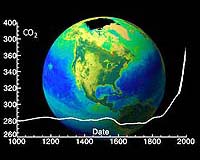
Boulder, CO (UPI) Jul 6, 2004 Many scientists and environmentalists would list global climate change among the most important issues facing the world today, but the general public seems to regard the subject as tedious. The Gallup Organization reported in April, for example, that the public is, in effect, practically dozing on the issue. This is down from finding it a bit of a yawn a year earlier. Climate change has a public relations problem. Despite the real and costly issues it raises, it is just the weather, after all, and people have had to handle the weather all of their lives. Selling the public on the importance of climate change, then, requires a search for what National Center for Atmospheric Research senior scientist Michael Glantz calls the dread factor. At first, the dread factor is CO2 doubling, Glantz told United Press International. That didn't catch on, so they went to the West Antarctic ice sheet collapse. Then three degrees (Celsius) increase in (global temperature in) a hundred years. Most people don't know what C is. If you live in Minnesota, it sounds OK -- until you find out that you can't go cross country skiing. The dread list continues, Glantz said. They came up with thermohaline circulation breakdown. Then abrupt climate change on the order of decades. They keep trying to get the hook in. I don't think these are the arguments that catch people. The climate change priesthood is looking for something as attention-getting as the ozone hole. The international effort to address the depletion of atmospheric ozone can probably be called the most successful environmental effort ever. In 1985, British researchers reported a massive reduction in ozone concentrations above Antarctica -- an ozone hole. In 1986 and 1987, National Oceanic and Atmospheric Administration scientist Susan Solomon pretty firmly established the cause of the depletion was the use of chlorofluorocarbons, the coolant in most air conditioners and the propellant in household spray cans -- the ozone layer was being sacrificed for underarm deodorant and stick-free frying pans. By May 1989, 36 countries had ratified the Montreal protocol on CFCs, banning them in most of the world and giving the story a happy ending. CFCs are long-lived in the atmosphere -- about 50 years -- but Solomon said she plans to live long enough to see the end of the ozone hole. The episode showed that when a clear environmental threat is identified and brought home to the public, the response can be strong enough to power coordinated and effective global action. In the case of ozone depletion, the identified threat was fear of a dramatic increase in skin cancer. That seemed to get people's attention. The climate change version of Montreal is, of course, the Kyoto Protocol, which has had tough sledding in the world community. The fear of skin cancer got action on ozone depletion, Glantz said. Even though there was no direct proof of this, the fear of it was enough. With global warming, they haven't figured out how to bring it to the individual -- how to make it personal. Not that the climate issue lacks fearsome threats -- sea level rise, for instance. Hundreds of millions of people worldwide live on the seacoasts in large cities, and millions more farm the fertile coastal deltas. Global sea level has risen at the rate of 1.8 millimeters per year over the last 50 years. That rate likely will increase over the next 100 years to 5 millimeters a year, according to John Church, an oceanographer with Australia's Commonwealth Scientific & Industrial Research Organization's marine research office in Hobart, Tasmania. Most of this increase comes from thermal expansion of the ocean's waters, but now there are indications the massive Greenland ice sheet is also melting. It appears from the satellite observations that he ice sheet is melting faster now than it was 10 years ago, said Jonathan Overpeck, director of the Institute for the Study of Planet Earth at the University of Arizona in Tucson. The last time the northern hemisphere was this warm -- 130,000 years ago -- sea level was 3 meters to 6 meters higher (10 feet to 20 feet). This was probably the result of the Greenland ice sheet melting. We will be as warm as it was then in about 100 years. We think that it melted then at the rate of meters per century -- not centimeters. The threat from higher sea level is not so far away as that, though. Rising seas eventually will submerge a lot of coastal areas, but the immediate threat is from more frequent extreme events, as they are called. Even without an increase in storm severity -- a possible, though uncertain, result of climate warming -- the increase in sea level means maximum storm surges will occur more frequently, along with their attendant damages. A study of data from Australia, for instance, comparing the beginning of the 20th century with the end, shows maximum storm surges now are occurring three times as often. In other words, what used to be a once-in-100-years storm -- on which many insurance policies are based -- now becomes a one-in-33-years storm. The problem is even worse in England, where the 100-year storm becomes a once-every-10-years storm, according to studies there. The massive flood barrier installed on the Thames River to protect London from floods has had to be raised 25 times since its completion in 1982. Still, the slogan, Don't Buy Beachfront Property, does not appear to be one that rallies the populace. What about more widespread disease? Rita Colwell, a professor at the Johns Hopkins School of Public Health, and former head of the National Science Foundation, said her research has found that cholera outbreaks appear to be related to climate change. Warming temperatures are warming the sea water, creating a fertile breeding ground for cholera bacteria. Colwell has found a link between climate change and cholera outbreaks in South America and Asia, as well as increases in cholera bacteria populations (though not outbreaks of the disease) in the Chesapeake Bay. There have also been fears that diseases now largely confined to the tropics -- malaria, dengue fever and others -- will migrate northward with changing climate, though there is little evidence of this so far and some scientists warn about inciting fears, either prematurely or erroneously. A paper by Dr. Paul Reiter, head of Insects and Infectious Disease at the Pasteur Institute in Paris, says that, in the case of malaria, at least, this fear is based partly on a necessity to simplify things for public consumption ... it is immoral for political activists to mislead the public by attributing the recent resurgence of these diseases to climate change, particularly in Africa. There are other threats that may or may not be associated with long-term changes in climate. Thousands of people died in France last year from a prolonged heat wave. This is another example of an extreme event that may become more frequent with a warming global climate. The severe floods in Europe also have been blamed on global climate change in some quarters. Nevertheless, the general populace seems unmoved. It is, after all, just the weather, and everyone knows nothing can be done about the weather. All rights reserved. Copyright 2004 by United Press International. Sections of the information displayed on this page (dispatches, photographs, logos) are protected by intellectual property rights owned by United Press International. As a consequence, you may not copy, reproduce, modify, transmit, publish, display or in any way commercially exploit any of the content of this section without the prior written consent of by United Press International. Community Email This Article Comment On This Article Related Links SpaceDaily Search SpaceDaily Subscribe To SpaceDaily Express Earth Observation News - Suppiliers, Technology and Application
 New Legislation Initiated To Support Commercial Remote Sensing Industry
 New York NY (SPX) Jan 11, 2006
The importance of remotely sensed data and technologies to support natural disasters has prompted attention and action in Washington. New initiatives and legislation authorizing appropriations to the remote sensing industry will be discussed at Strategic Research Institute's U.S. Commercial Remote Sensing Industry conference, scheduled for February 9-10, 2006 in Washington D.C. |
|
|

| The content herein, unless otherwise known to be public domain, are Copyright 1995-2006 - SpaceDaily.AFP and UPI Wire Stories are copyright Agence France-Presse and United Press International. ESA PortalReports are copyright European Space Agency. All NASA sourced material is public domain. Additionalcopyrights may apply in whole or part to other bona fide parties. Advertising does not imply endorsement,agreement or approval of any opinions, statements or information provided by SpaceDaily on any Web page published or hosted by SpaceDaily. Privacy Statement |