|
 |
 |
 |
 |
 |
 |
 |
 |

 |
Climate Protection Tops EU Plan
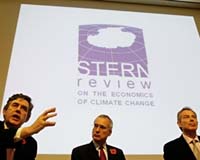
UPI Germany Correspondent Berlin (UPI) Jan 10, 2007 A new European Commission study on climate change has warned of drought-like conditions, catastrophic damage to the economy and tens of thousands of deaths if urgent steps are not taken to contain global warming. The study is part of a greater overhaul of Europe's energy policy, which was unveiled Wednesday in Brussels. It puts the issue of climate change onto the center stage of European politics. "The challenges of climate change, increasing import dependence and higher energy prices are faced by all European Union members," Commission President Jose Manuel Barroso said. "A common European response is necessary to deliver sustainable, secure and competitive energy." The study cites catastrophic consequences for the continent if global warming continues in the same rate as during the 1990s, which would be between 4 and 5.4 degrees Fahrenheit. Were this to happen, much of Europe's agricultural top sellers such as vine, grain and dairy products would be greatly affected, along with tourism, another huge European industry. If temperatures rise by more than 5 degrees, wave goodbye to your ski trip in the Alps (there will not be much snow left) and forget about hopping to Greece or Spain in the summer, where it will simply be too hot to enjoy your beach vacation. Moreover, tens of thousands of Europeans will die because of an increase in heat waves and extreme weather events, such as storms and floods. Experts are worried that the trend can't be stopped anymore. "(Climate change) is by far the world's greatest problem, and, unlike energy supply problems, there comes a moment when you can't control climate change anymore," Roland Goetz, energy expert at the German Institute for International and Security Affairs, recently told United Press International. "This will be a problem that will dominate for the next years. If emissions continue to climb, soon enough, nature will hit back." Yet that's just what the commission wants to prevent. To ensure that temperatures won't rise by more than 3.6 degrees F, EU countries must, by 2020, reduce greenhouse gas emissions by at least 20 percent below 1990 levels, the commission said Wednesday, adding that the drop would be increased to 30 percent if the international community agrees to more cuts. "Today we have agreed on a set of ambitious but realistic targets which will support our global efforts to contain climate change and its most dire consequences," Environment Commissioner Stavros Dimas said. "I urge the rest of the developed world to follow our lead, match our reductions and accelerate progress toward an international agreement on the global emission reductions." The EU's new strategy also calls for ending the dependence on oil and gas by increasing the use of renewable energy sources, such as solar energy, wind power and biofuels. The body will also increase by at least 50 percent its yearly spending on research for green energy sources for the next seven years. Climate change has in the past few months taken the center stage of global politics with a series of forecasts that have shed light onto the catastrophic side-effects of global warming. The EU's strategy change comes a few months after a report on climate change by former World Bank chief economist Nicholas Stern handed a long-overdue wake-up call to the world's politicians. Failure to tackle climate change would cost the world economy some $7 trillion by 2050, the report said. The economic recession would be followed by social unrest and a threat to European security, as Africans, whose countries are going to be hit by still more massive droughts, push northward in larger numbers. "Without action, droughts, floods and rising sea levels would mean that up to 200 million people could be displaced," the report said. Germany, which on Jan. 1 took over the EU and Group of Eight presidencies, said it will make climate protection one of the key issues of its G8 summit, which will be held in June of this year. But it's not only climate change that has caused the EU to update its energy security strategy: The hike in oil prices, recent power blackouts across Europe and a potentially dangerous dependency on Russia as an energy supplier also called for the new policy approaches.
Source: United Press International Community Email This Article Comment On This Article Related Links European Commission Learn about Climate Science at TerraDaily.com Climate Science News - Modeling, Mitigation Adaptation
 Melted Sea Ice Absorbs Carbon Dioxide Offsetting Some GW Impact
 Kingston (UPI) Jan 08, 2007
Melting Arctic sea ice allows the ocean to absorb carbon dioxide from the atmosphere, offsetting some global warming effects, scientists said in Jamaica. Ice melting during the last 30 years tripled the amount of carbon dioxide the Arctic Ocean can absorb, New Scientist said Monday. |
|
|

| The content herein, unless otherwise known to be public domain, are Copyright 1995-2006 - SpaceDaily.AFP and UPI Wire Stories are copyright Agence France-Presse and United Press International. ESA PortalReports are copyright European Space Agency. All NASA sourced material is public domain. Additionalcopyrights may apply in whole or part to other bona fide parties. Advertising does not imply endorsement,agreement or approval of any opinions, statements or information provided by SpaceDaily on any Web page published or hosted by SpaceDaily. Privacy Statement |