|
 |
 |
 |
 |
 |
 |
 |
 |

 |
Climate: Low-Carbing The Atmosphere
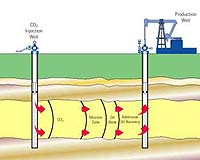
Boulder CO (UPI) Jan 31, 2005 Carbon sequestration has become the leading weapon in the U.S. government's arsenal against climate change. There is a hoary saying in the business world that is easier to save a dollar than to make a dollar, but this advice seems to be cheerfully ignored in the U.S. climate policy arena. There, a technology-investment fix is being promoted over a regulatory approach that restricts carbon emissions - that is, not emitting the greenhouse gas in the first place. Former Energy Secretary Spencer Abraham outlined the Bush administration's plans at meeting on the subject in 2003 in Virginia. He said about $110 million in public and private funds would be invested in 65 carbon sequestration projects around the country. The federal portion of sequestration efforts would be $62 million and the administration would engage in regional partnerships, as Abraham called them, to determine the most suitable ways to capture and store greenhouse gases. Carbon sequestration is not a single activity. There are many potential ways to store it. One suggestion is to sink it in the deep ocean, a technique that would isolate the carbon for quite some time, but eventually the natural ocean circulation would bring it to the surface again. "Sequestering carbon in the deep ocean is, at best, a technique to buy time," said Atul Jain, a professor of atmospheric sciences at the University of Illinois at Urbana-Champaign, who has studied the issue. "Carbon dioxide dumped in the oceans won't stay there forever. Eventually it will percolate to the surface and into the atmosphere." Even the ocean's ability to absorb carbon is limited, however, and its capacity is negatively influenced by global warming. As sea surface temperatures increase, water density decreases and so does the ability of the ocean to absorb ca rbon. Soil is one of the most efficient carbon storers, so another strategy for sequestration is to encourage farmers to adopt practices that increase the carbon uptake of the soil. One such test is underway at the University of Kansas in Lawrence - some of that $110 million Abraham mentioned. Researchers are trying no-till and low-till cultivation, creating composts of grains, changing their crop rotations and incorporating trees into their lands, all in an effort to keep more CO2 out of the atmosphere. The trouble is, these practices require expensive new equipment - making a dollar is harder than saving a dollar - and there is no financial incentive to adopt them. No grocery stores yet offer premium prices for high-carbon-sequestration soy beans. Another strategy is pumping CO2 into depleted oil reservoirs. Anadarko Petroleum, for instance, is injecting the gas into a an old formation in Wyoming's Salt Creek Basin, both to store the CO2 long-term and produce more oil from the field. The University of Alberta in Edmonton is operating a similar project to produce oil and store CO2 at the same time. So far, however, no one has calculated whether burning the new oil offsets the benefits of storing the carbon. Another efficient way to sequester carbon is in trees. A recent report by the Pew Center on Global Climate Change found that growing more trees in the United States could store about 300 million tons of carbon a year, with costs ranging from $25 per ton and $75 per ton. Storing 500 million tons per year would cost more - from $30 per ton to $90 per ton. One big potential drawback would be reserving the land required for growing the trees. Sequestering 300 million tons of carbon would require about 140 million acres of land. That is an area just slightly smaller than the state of Texas. The United States already has dedicated about 100 million acres of land to wilderness, but not all of the new land required would have to be concentrated in one place. "Every agricultural region has land that would be a good candidate for conversion to forest," Kenneth Richards, of Indiana University, one of the Pew study authors, told UPI's Blue Planet. "The total of U.S. range and pasture land is on the order of 1 billion acres, so you would only need about 15 percent of the total." Of that 1 billion acres, Richards added, "not all is suitable for conversion to forests, but a significant portion is. About one-third of all crop land would be considered environmentally sensitive or economically marginal (which is) about the right amount" for carbon storage. The land requirements would be large, but the contribution to greenhouse-gas mitigation would be significant, because 300 million tons represents about one- third of the U.S. total of carbon emissions. Another issue related to carbon sequestration is making sure the CO2 stays where it is stored over the long periods necessary to have a mitigating impact on the climate system - hundreds or maybe thousands of years. A timeframe that large makes the sequestration problem somewhat analogous to storing commercial nuclear wastes: Human administrative systems weaken or collapse and budget priorities simply change. One cannot simply erect a sign saying, "Carbon stored here, do not disturb," because signs fall down. Even the meaning of language changes over long historical timeframes. Despite such difficulties - circulating oceans, reluctant farmers, diminishing wilderness and collapsing warning billboards, to recap a few - both the Bush administration and environmentalists see promise in sequestration. "The tendency to overlook sequestration opportunities can lead to incorrect and overly pessimistic conclusions about both the cost and feasibility of addressing global climate change in the decades ahead," Pew Center president Eileen Claussen said in the report's introduction. "Sequestration can play an important role in future mitigation efforts and must be included in comprehensive assessments of policy responses to the problem of global climate change." Climate is a weekly series examining the potential human impact on global climate change, by environmental reporter Dan Whipple. All rights reserved. Copyright 2004 by United Press International. Sections of the information displayed on this page (dispatches, photographs, logos) are protected by intellectual property rights owned by United Press International. As a consequence, you may not copy, reproduce, modify, transmit, publish, display or in any way commercially exploit any of the content of this section without the prior written consent of by United Press International. Community Email This Article Comment On This Article Related Links SpaceDaily Search SpaceDaily Subscribe To SpaceDaily Express Earth Observation News - Suppiliers, Technology and Application
 New Legislation Initiated To Support Commercial Remote Sensing Industry
 New York NY (SPX) Jan 11, 2006
The importance of remotely sensed data and technologies to support natural disasters has prompted attention and action in Washington. New initiatives and legislation authorizing appropriations to the remote sensing industry will be discussed at Strategic Research Institute's U.S. Commercial Remote Sensing Industry conference, scheduled for February 9-10, 2006 in Washington D.C. |
|
|

| The content herein, unless otherwise known to be public domain, are Copyright 1995-2006 - SpaceDaily.AFP and UPI Wire Stories are copyright Agence France-Presse and United Press International. ESA PortalReports are copyright European Space Agency. All NASA sourced material is public domain. Additionalcopyrights may apply in whole or part to other bona fide parties. Advertising does not imply endorsement,agreement or approval of any opinions, statements or information provided by SpaceDaily on any Web page published or hosted by SpaceDaily. Privacy Statement |