|
 |
 |
 |
 |
 |
 |
 |
 |

 |
Climate Change Plan Takes Heat Off US, Australia
Sydney (AFP) Jan 13, 2006 While environmentalists contend a climate change plan agreed by some of the world's worst polluters this week will do little to halt global warming, analysts say it will reduce political pressure on the United States and Australia to sign the Kyoto Protocol. Both Canberra and Washington have refused to ratify the protocol because they say its greenhouse gas emission targets unfairly impact on their economies while favouring developing nations. This week's inaugural Asia-Pacific Partnership on Clean Development and Climate (AP-6) meeting in Sydney was designed to find an alternative strategy palatable to business, developing nations and the Kyoto rebels. The meeting brought ministers from the United States, Australia, Japan, China, India and South Korea together with more than 100 top executives from big business. Analysts said the two-day meeting ended with little concrete outcome, aside from the the allocation of a relatively small amount of money to address climate problems and the articulation of a number of core principles. These included assigning private enterprise the bulk of work to halt global warming, acknowledging fossil fuels will continue to provide most of the world's energy needs for the next 50 years and refusing to sacrifice economic growth in order to stop global warming. The key to achieving this, according to Australian Prime Minister John Howard, is encouraging industry to develop and commercialise high-technology methods of reducing carbon emissions. The strategy won support from an unexpected quarter, Australia's Labor Party opposition, which is normally opposed to initiatives from Howard's conservative government. "It's time to abandon the political correctness espoused by the green movement," Labor's resources spokesman Martin Ferguson wrote in the Australian newspaper. "Let's be real: without getting business on board we cannot achieve anything. The environmentalists are simply attacking the coal industry for the sake of it." The Australian Chamber of Industry and Commerce (ACCI) also welcomed the AP-6's approach, which does not include the mandatory emission reduction targets contained in Kyoto. "(It) represents a significant step beyond the flawed Kyoto Protocol as it involves business, and deals in the practical aspects of implementing low emission technologies," ACCI chief executive Peter Hendy said. However, Clive Hamilton, the chairman of Australia's Climate Institute, which aims to raise public awareness about global warming, said the conference was a "talk-fest" that did not live up to even minimal expectations. "The main purpose of the partnership, which was always to give diplomatic cover to the US and Australia, seems to have been achieved," he told AFP. Hamilton said the government's own modelling showed that the partnership would have a minimal impact on greenhouse gas pollution, with emissions doubling from their present level by 2050. It was also absurd to say that business had previously been locked out of climate change debate, he added. "The idea that AP-6 has some how given a voice to a disenfranchised business community is laughable," he said. American Electric Power chief Michael Morris said only time would reveal if the partnership had been a success. "The real question now is what are we going to do next to learn from each other and share all the best practices so that we see improvements on a worldwide basis," Morris told reporters. "The test will be six months from now (to see) what we have done."
Source: Agence France-Presse Community Email This Article Comment On This Article Related Links SpaceDaily Search SpaceDaily Subscribe To SpaceDaily Express Climate Science News - Modeling, Mitigation Adaptation
 Aussie Climatologists Contend With A New Trend
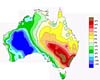 Sydney, Australia (SPX) Jan 17, 2006
Australia is hotter, on average, by one degree, than it was a century ago, while the frequency of higher temperatures is gradually increasing, say Australian meteorologists, who've identified a new trend in the continent's naturally variable climate. |
|
|

| The content herein, unless otherwise known to be public domain, are Copyright 1995-2006 - SpaceDaily.AFP and UPI Wire Stories are copyright Agence France-Presse and United Press International. ESA PortalReports are copyright European Space Agency. All NASA sourced material is public domain. Additionalcopyrights may apply in whole or part to other bona fide parties. Advertising does not imply endorsement,agreement or approval of any opinions, statements or information provided by SpaceDaily on any Web page published or hosted by SpaceDaily. Privacy Statement |