|
 |
 |
 |
 |
 |
 |
 |
 |

 |
Climate Change May Become Major Player In Ozone Loss
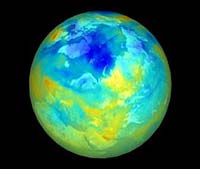
Greenbelt - June 4, 2002 While industrial products like chlorofluorocarbons are largely responsible for current ozone depletion, a NASA study finds that by the 2030s climate change may surpass chlorofluorocarbons (CFCs) as the main driver of overall ozone loss. Drew Shindell, an atmospheric scientist from NASA's Goddard Institute for Space Studies (GISS) and Columbia University, N.Y., finds that greenhouse gases like methane and carbon dioxide are changing the climate in many ways. Some of those effects include water vapor increases and temperature changes in the upper atmosphere, which may delay future ozone recovery over heavily populated areas. Scientists have expected the ozone layer to recover as a result of international agreements to ban CFCs that destroy ozone. CFCs, once used in cooling systems and aerosols, can last for decades in the upper atmosphere, where they break down, react with ozone, and destroy it. They remain the major cause of present-day ozone depletion. "It's hard to tell if those great international agreements [to ban CFCs] work if we don't understand the other big things that are going on in the stratosphere, such as increases in greenhouse gases and water vapor," Shindell said. The stratosphere is a dry atmospheric layer between 6 and 30 miles (9.7 and 48.3 kilometers) up where most ozone exists. Ozone shields the planet's surface from the Sun's harmful ultraviolet radiation and makes life on Earth possible. The study examined the ozone layer over heavily populated areas around the equator and mid-latitudes where ozone thinning occurs, excluding the Polar regions, where 'ozone holes' form. Ozone thinning can occur when increased emissions of methane get transformed into water in the stratosphere. At high altitudes, water vapor can be broken down into molecules that destroy ozone. Also, methane and carbon dioxide change our climate by trapping heat in the atmosphere before it can escape out to space. This greenhouse effect, much like the inside of a car with all the windows closed, heats the air within the lowest layer of the atmosphere, called the troposphere. Warming in the troposphere can alter atmospheric circulation and make the air wetter, since warmer air holds more water. Though complex and not well understood, there is evidence that water vapor can get wafted from the troposphere into the stratosphere by shifting air currents caused by climate change. Climate change from greenhouse gases can also affect ozone by heating the lower stratosphere where most of the ozone exists. When the lower stratosphere heats, chemical reactions speed up, and ozone gets depleted. The chemical and atmospheric processes in the lower stratosphere are complex, quite variable, and not well understood. Shindell focused his study largely on the upper stratosphere where processes are simpler and better understood, and then used those findings to make inferences about ozone in the lower stratosphere. Computer model simulations were used to separate the different factors that contribute to ozone changes. According to the models, which contain some uncertainty, ozone levels are expected to reach their lowest point in recorded history by around 2006. Scientists hope that by banning CFCs, ozone will eventually return to healthier levels, like those that existed prior to 1979. One simulation isolated the impacts of CFCs on ozone, and showed that as CFCs decline, by the year 2040 overall ozone makes close to a full recovery from current low levels. When CFCs, water vapor and temperature changes were all combined in a computer model, by 2040, overall ozone levels recovered only slightly from their current low point. These computer simulations suggest that climate change from greenhouse gases may greatly slow any anticipated ozone recovery. Shindell said the effects of climate change need to be better accounted for as scientists and others try to track the success of international agreements, like the 1987 Montreal Protocol that banned CFCs. The paper appears in the latest issue of the Journal of Geophysical Research - Atmospheres. The study was supported by NASA's Atmospheric Chemistry Modeling and Analysis Program, and a NASA Earth Observing System postdoctoral Fellowship. Some of the data used was obtained from the NASA Langley Research Center's EOSDIS Distributed Active Archive Center. Community Email This Article Comment On This Article Related Links SpaceDaily Search SpaceDaily Subscribe To SpaceDaily Express Dirt, rocks and all the stuff we stand on firmly
 Environmental Damage Threatens Human Health
 Bangkok (AFP) Dec 9, 2005
Environmental damage threatens human health and may have contributed to the spread of new diseases like bird flu and SARS, the World Health Organization said in a report Friday. |
|
|

| The content herein, unless otherwise known to be public domain, are Copyright 1995-2006 - SpaceDaily.AFP and UPI Wire Stories are copyright Agence France-Presse and United Press International. ESA PortalReports are copyright European Space Agency. All NASA sourced material is public domain. Additionalcopyrights may apply in whole or part to other bona fide parties. Advertising does not imply endorsement,agreement or approval of any opinions, statements or information provided by SpaceDaily on any Web page published or hosted by SpaceDaily. Privacy Statement |