
 |
 |
 |
 |
 |
 |
 |
 |
 |

 |
Climate Change Caused Widespread Tree Death In California Mountain Range
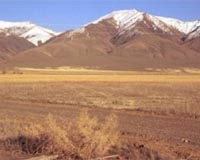
Irvine CA (SPX) Aug 13, 2008 Warmer temperatures and longer dry spells have killed thousands of trees and shrubs in a Southern California mountain range, pushing the plants' habitat an average of 213 feet up the mountain over the past 30 years, a UC Irvine study has determined. White fir and Jeffrey pine trees died at the lower altitudes of their growth range in the Santa Rosa Mountains, from 6,400 feet to as high as 7,200 feet in elevation, while California lilacs died between 4,000-4,800 feet. Almost all of the studied plants crept up the mountain a similar distance, countering the belief that slower-growing trees would move slower than faster-growing grasses and wildflowers. This study is the first to show directly the impact of climate change on a mountainous ecosystem by physically studying the location of plants, and it shows what could occur globally if the Earth's temperature continues to rise. The finding also has implications for forest management, as it rules out air pollution and fire suppression as main causes of plant death. "Plants are dying out at the bottom of their ranges, and at the tops of their ranges they seem to be growing in and doing much better," said Anne Kelly, lead author of the study and a graduate student in the Department of Earth System Science at UCI. "The only thing that could explain this happening across the entire face of the mountain would be a change in the local climate." The study appears online the week of Aug. 11 in the Proceedings of the National Academy of Sciences. Kelly and Michael Goulden, Earth system science professor, studied the north face of the Santa Rosa Mountains, just south of Palm Desert near Idyllwild, Calif. In the past 30 years, the average temperature there rose about 2 degrees Fahrenheit. While overall precipitation increased, the area experienced longer periods of drought, specifically in 1987-1990 and 1999-2002. They decided to study the area after learning that people who live and work there were speculating that climate change was causing the plants to die. Kelly and Goulden began with a 1977 plant survey by researcher Jan Zabriskie that cataloged all plants along a five-mile vertical stretch through the desert scrub, pinyon-juniper woodland, and chaparral shrubland and conifer forest. The UCI scientists went back to the same spot in 2006-07 and did another plant survey, in which they stretched a measuring tape along the route and physically identified and measured plants that covered the tape. Then with a computer, they compared their results with those of the 1977 survey. In the UCI study, 141 different species were identified along the tape, but the final analysis focused on 10 that were most abundant at different elevations. Those species included white fir and Jeffrey pine trees; golden cup oak trees; sugar bush, California lilac, Muller scrub oak, creosote bush, ragweed, and brittle bush shrubs; and agave plants. The mean elevation of nine of the 10 species rose, with an average gain of 213 feet. "I was surprised by how nice the data looked and how unambiguous the signal was," Goulden said. "It is clear that ecosystems can respond rather rapidly to climate change." The scientists say air pollution did not kill the trees or cause the shift because the area does not have unusually high carbon dioxide levels, and they did not observe the characteristic speckling on plants caused by ozone damage. Also, if it was pollution, all of the plants would be suffering, not just the ones at the bottom of their range. Fire suppression also is not a culprit, they say. The fire regime there is normal, with the last major fire occurring in the 1940s. "The plants should still be in a recovery phase where they are growing back in," Kelly said. "But they have stopped recovering and now are dying, which these plants should not be doing." A study published recently in the journal Science also found that plant growth ranges are moving upward in a French mountain range, but its conclusions were based on historic databases, not a systematic, repeated measurement of plant cover. The UCI study also found that all types of plants, from pine trees to ragweed, moved up a similar distance, not just small, short-lived plants as found by the French scientists. Community Email This Article Comment On This Article Share This Article With Planet Earth
Related Links University of California - Irvine Forestry News - Global and Local News, Science and Application
 Forest Survives Revolutionary War Better Than Modern Times
 University Park PA (SPX) Aug 12, 2008
Inwood Hill Park survived the drastic modifications of Revolutionary War patriots, but preserving this last bastion of large-growth, mature trees in New York City is difficult with the proliferation of invasive species and hard human use, according to biologists. They suggest the situation warrants a plan in collaboration with those studying the park. |
|
|

| The content herein, unless otherwise known to be public domain, are Copyright 1995-2007 - SpaceDaily.AFP and UPI Wire Stories are copyright Agence France-Presse and United Press International. ESA Portal Reports are copyright European Space Agency. All NASA sourced material is public domain. Additional copyrights may apply in whole or part to other bona fide parties. Advertising does not imply endorsement,agreement or approval of any opinions, statements or information provided by SpaceDaily on any Web page published or hosted by SpaceDaily. Privacy Statement |
 del.icio.us
 Digg
Digg Reddit
 YahooMyWeb
 Google
 Facebook