|
 |
 |
 |
 |
 |
 |
 |
 |

 |
Climate: A Race Through Thick And Thin Ice
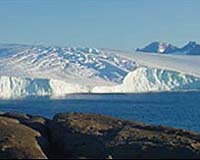
Boulder (UPI) May 23, 2005 The interior of the East Antarctic ice sheet is gaining mass because of increased snowfall there, a development that should offset sea level rise from other sources around the globe. The East Antarctic ice sheet is the world's largest, containing enough water equivalent to raise worldwide sea level by more than 50 meters (164 feet). The researchers who examined 7.1 million kilometers of the ice sheet using satellite radar found it is the only large, terrestrial ice area that is gaining mass rather than losing it. Because the area is so large, its' impact on sea level can be significant, however. The work, published in this week's journal Science, was done by a team led by University of Missouri-Columbia electrical and computer engineering Professor Curt Davis. The group found the ice sheet's interior was gaining mass by about 25 billion tons per year, enough to offset an annual sea level rise of 0.12 millimeters (0.005 inches). "It is very likely that the area of East Antarctica not covered by our satellite observation is also growing," Davis told UPI's Climate. "It could easily be 0.18 mm (0.007 inches). That 0.18 mm would be enough to balance out the recent estimate for contribution to sea level rise from the Greenland ice sheet." The finding that the ice sheet is growing is consistent with the current consensus of scientific opinion on global warming. The air is warmer, so it can hold more moisture and more snow falls. Most climate models have predicted this area of the globe would increase its total snow cover. "This is a really important paper," University of Colorado National Ice and Snow Data Center glaciologist Ted Scambos told Climate. "The IPCC (Intergovernmental Panel on Climate Change) had long suspected that one of the main components that could mitigate sea level rise would be increased precipitation over the East Antarctic ice sheet. "Now we've got our first good data point scaling what kinds of things are going on and how much of the recurring signal it maybe offsetting. It's a reference point," he said. The next question, Scambos said, is whether additional snowfall is enough to offset contributions from other sea level changes that are attributable to ice. "It shows a pretty clear signal," Scambos said, "and it seems to be a pretty reliable result. It's still not offsetting all of the outflow, but it is a pretty good part of it." Over the past 10 years, observed average sea level rise has been close to 3 mm (0.12 inches) per year. There are three main contributions to sea level rise: thermal expansion of the oceans, plus melting of glaciers, minus the amount of water stored on land. The estimates of observed rise and the contributions from various inputs do not quite add up. Kevin Trenberth, head of the National Center for Atmospheric Research in Boulder, said the best estimate for the melting glaciers is between 0.6 and 1 mm per year (0.02 to 0.04 inches). Expansion of ocean waters is estimated at 1.6 mm per year (0.06 inches). Inland water storage on land has increased by about 0.9 mm (0.04 inches) per year. Scientists are uncertain about the source of the discrepancy in the numbers. There recently have been unexpected developments in the western Antarctic - floating ice shelves have collapsed, glaciers have thinned and also speeded up - potentially contributing an unanticipated jolt to increasing sea level. The western Antarctic ice sheet is smaller than the eastern one, but it contains an estimated 5 meters (16.4 feet) of sea level rise. "If we continue on with business as usual," Richard Alley, professor of geosciences at Pennsylvania State University, told a conference last year, "we are likely to move CO2 (carbon dioxide) to levels that, when they last existed, there were no ice sheets on Earth." Alley said there are many factors involved, and these elevated CO2 levels do not necessarily mean the loss of the ice sheets. For one thing, they are not that easy to kill. "It's much harder to get rid of an ice sheet than to create one," Alley said. "But I don't think we can exclude the possibility of losing one or both of the Greenland or west Antarctic ice sheets over centuries," Alley said. "Were it to happen -- and they are now changing 10 times faster than we're used to -- it moves Miami Beach north of the Everglades, and maybe north of Florida." The researchers used satellite radar altimeters from the European Space Agency's satellites to make 347 million elevation-change measurements between June 1992 and May 2003. They found the interior was gaining mass but, in part because the satellites did not cover all of the ice sheet, they did not assess the overall contribution of the ice sheet to sea level rise. So Antarctica is seeing a climate race between two competing tortoises -- melting and snowfall. The winner between these slow but steady processes is still to be determined. Scambos said the study points out that the ice sheets and climate are a complex system with competing processes. "The race is on," he said. "Which will be the dominant process: the snow fall on the ice sheets or the feedbacks on the edges that increase sea level?" As to which tortoise he believes will win, Scambos said: "I'm amazed at how many feedbacks there are. I'd put some money on the shrinkage outpacing the thickening -- but that's just a hunch." Climate is a weekly series examining the potential impact of global climate change, by veteran environmental reporter Dan Whipple. E-mail: [email protected] Community Email This Article Comment On This Article Related Links University of Missouri-Columbia SpaceDaily Search SpaceDaily Subscribe To SpaceDaily Express Earth Observation News - Suppiliers, Technology and Application
 New Legislation Initiated To Support Commercial Remote Sensing Industry
 New York NY (SPX) Jan 11, 2006
The importance of remotely sensed data and technologies to support natural disasters has prompted attention and action in Washington. New initiatives and legislation authorizing appropriations to the remote sensing industry will be discussed at Strategic Research Institute's U.S. Commercial Remote Sensing Industry conference, scheduled for February 9-10, 2006 in Washington D.C. |
|
|

| The content herein, unless otherwise known to be public domain, are Copyright 1995-2006 - SpaceDaily.AFP and UPI Wire Stories are copyright Agence France-Presse and United Press International. ESA PortalReports are copyright European Space Agency. All NASA sourced material is public domain. Additionalcopyrights may apply in whole or part to other bona fide parties. Advertising does not imply endorsement,agreement or approval of any opinions, statements or information provided by SpaceDaily on any Web page published or hosted by SpaceDaily. Privacy Statement |